1959 Mercedes-Benz 300 SL Roadster
Mercedes-Benz addressed the Gullwing coupe’s notorious snap oversteer when developing the 300 SL Roadster by relocating the rear swing axle’s pivot point lower in the chassis, creating a more benign, progressive handling balance at the limit.
Produced from 1957 through early 1963, the Roadster represented a thorough re-engineering rather than a simple convertible conversion, with 1,858 examples built for discerning enthusiasts.
The modified tubular space frame accommodated conventional front-hinged doors and lower sills, improving accessibility while maintaining the model’s trademark structural integrity and stiffness. Finished in a wide range of exterior colors over leather interiors and frequently ordered with both soft top and removable hardtop, the Roadster presented a more civilized alternative to its predecessor while retaining genuine long-distance GT capability.
Power came from a 3.0-liter SOHC inline-six with Bosch mechanical fuel injection, rated at roughly 215-225 horsepower depending on measurement standard and tuning. The four-speed manual transmission, independent front suspension, and swing-axle independent rear suspension (later complemented by four-wheel Dunlop disc brakes starting in 1961) provided serious performance for the era.
Early cars like a 1959 example used large finned drum brakes on all four corners, while later disc-brake/aluminum-block cars are now regarded as the most developed and desirable evolution.
Though slightly heavier than the Gullwing, the Roadster’s revised rear suspension geometry, improved cockpit ventilation, and easier entry and exit made it the preferred choice for many drivers who actually used their cars on the road.
Today, top-tier Roadster values generally track just below the most collectible alloy- or competition-spec coupes, with the best late disc-brake/aluminum-engine examples often approaching or matching all but the rarest Gullwings at auction.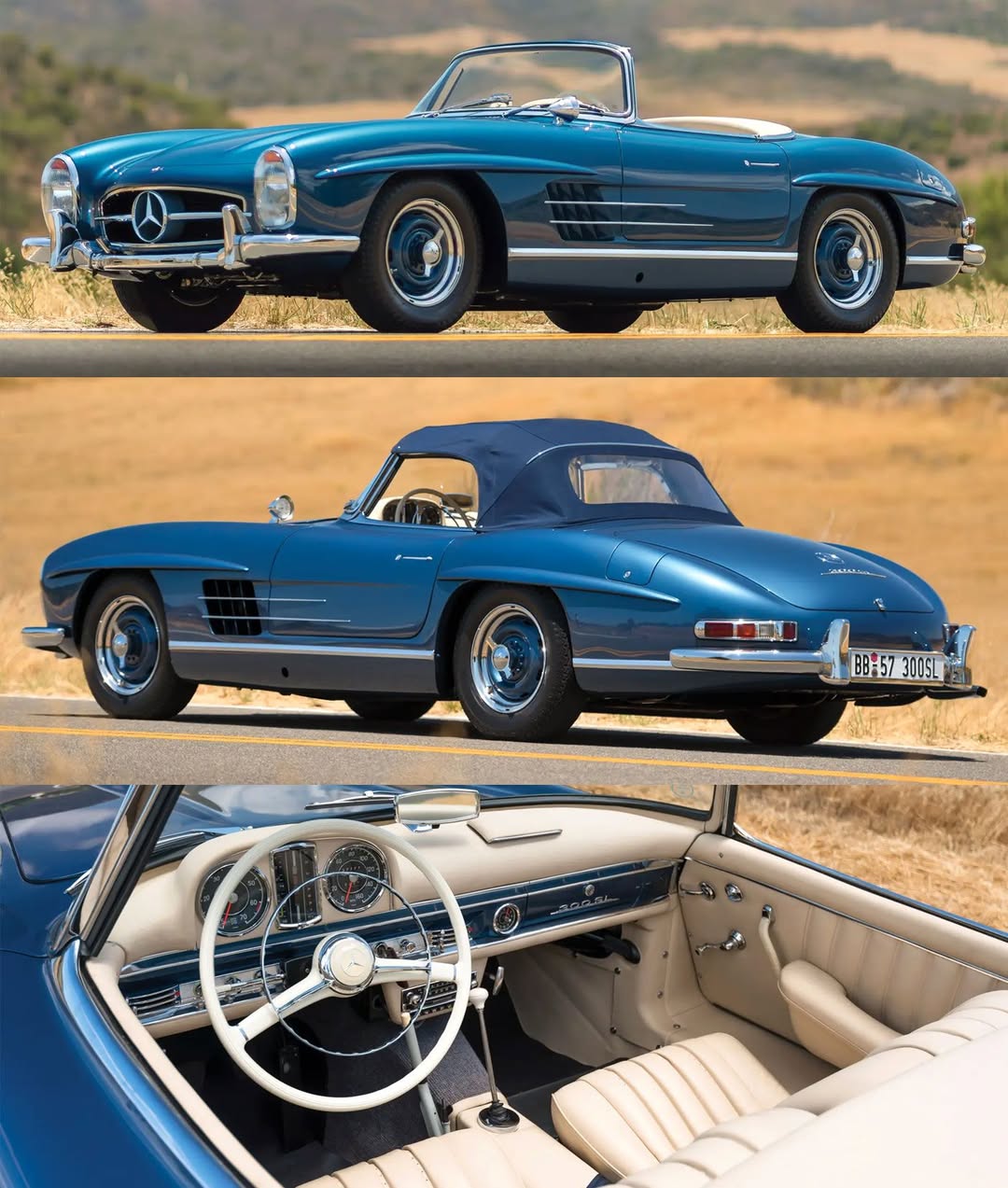
Source