1958 Facel Vega HK500
French manufacturer Facel Vega combined Parisian elegance with American V8 power in the HK500, an evolution of the FVS grand tourer featuring a distinctive stacked headlight design and pillarless coupe bodywork.
Jean Daninos’s company styled and built the hand-finished steel body over a tubular steel frame, with wishbone and coil spring front suspension and a live rear axle with leaf springs.
The aircraft-inspired dashboard presented what appeared to be burled wood but was actually hand-painted steel, chosen for durability and safety instead of genuine timber.
Often cited in period as one of the world’s fastest four-seat coupes, the HK500 was timed at around 147 mph in independent testing, reinforcing its reputation as a very high-speed grand tourer for its day.
Early HK500s used a Chrysler 5.8‑liter (about 354 cubic inch) V8 around 335 hp, with later cars adopting larger Chrysler wedge-head engines of about 5.9 to 6.3 liters, with outputs quoted up to about 360 hp in period and even higher in some later sources.
Power went to the rear wheels through either Chrysler’s 3‑speed TorqueFlite automatic or a French Pont‑à‑Mousson 4‑speed manual gearbox, a combination that helped give the car its dual character as both luxury cruiser and serious high-speed GT.
Finned alloy drum brakes were used at first, with front (and then four-wheel) disc brakes introduced as optional equipment and becoming standard during 1960.
Production was always limited and highly artisanal. Approximately 490 HK500s were built between mid‑1958 and 1961, with about 71 of those produced in 1958, the inaugural model year.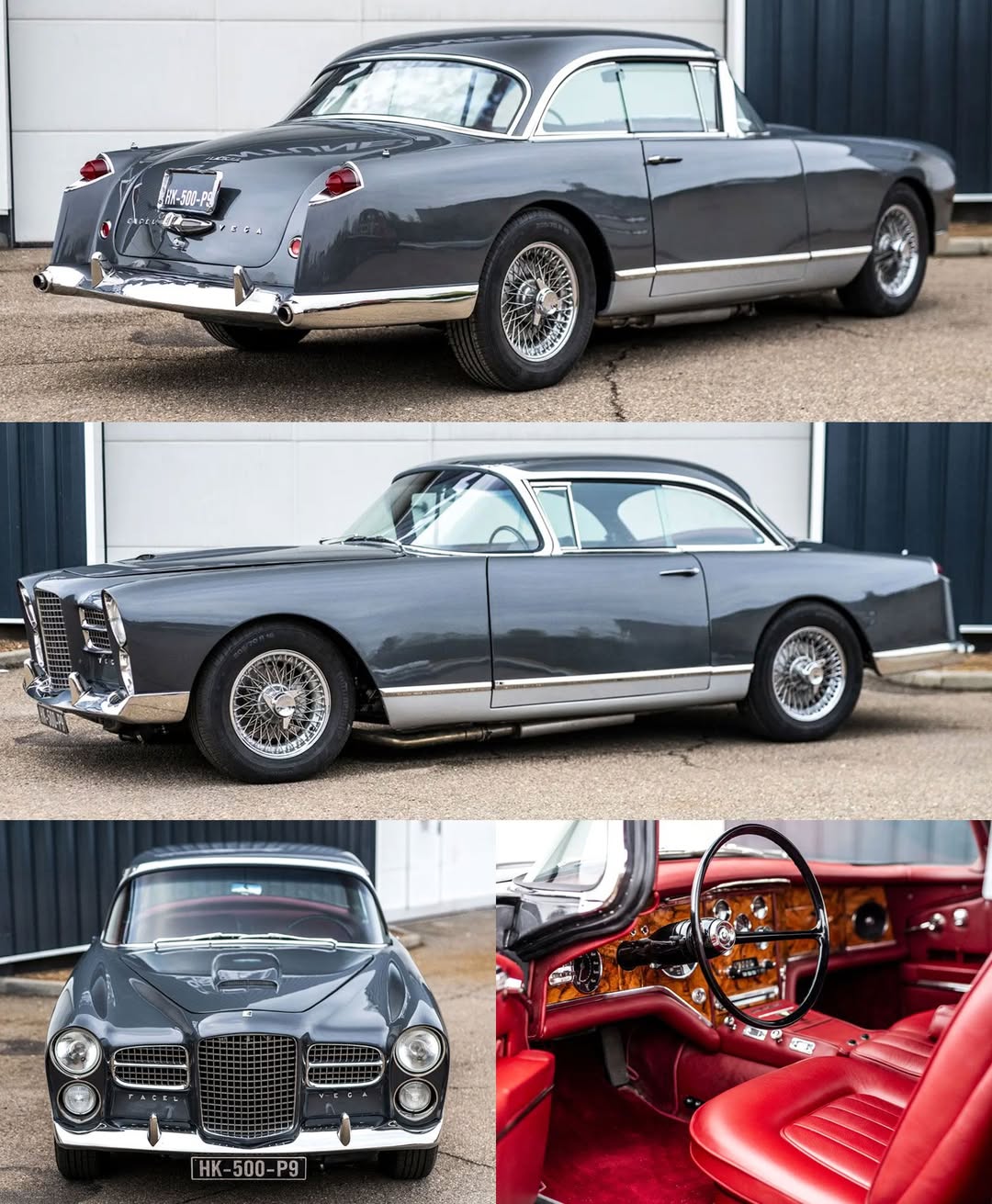
Source