1952 Hudson Hornet Sedan
Revolutionary unit-body construction defined Hudson’s 1948 “step-down” design, which placed floors between the frame rails rather than above them. This arrangement lowered the overall height to just 60 inches while creating a significantly lower center of gravity that transformed handling characteristics on racetracks across America.
The 308 cubic inch L-head straight-six represented the largest-displacement six-cylinder engine in mass-production American automobiles at the time. Twin H-Power, featuring dual single-barrel Carter carburetors on a split intake manifold, was standard equipment for 1952 and produced 170 horsepower.
This configuration allowed Hudson to dominate stock car racing despite competing against V-8-powered rivals from larger manufacturers.
Marshall Teague captured 12 victories from 13 AAA stock car races in 1952 driving his “Fabulous Hudson Hornet.” Hudson secured 27 wins from 34 NASCAR Grand National events that same season.
The welded unit-body structure provided exceptional rigidity without requiring a separate frame, though this sophisticated construction made annual styling updates prohibitively expensive compared to body-on-frame competitors.
Production totaled 35,921 Hornets in 1952 before declining sales led to Hudson’s 1954 merger with Nash-Kelvinator.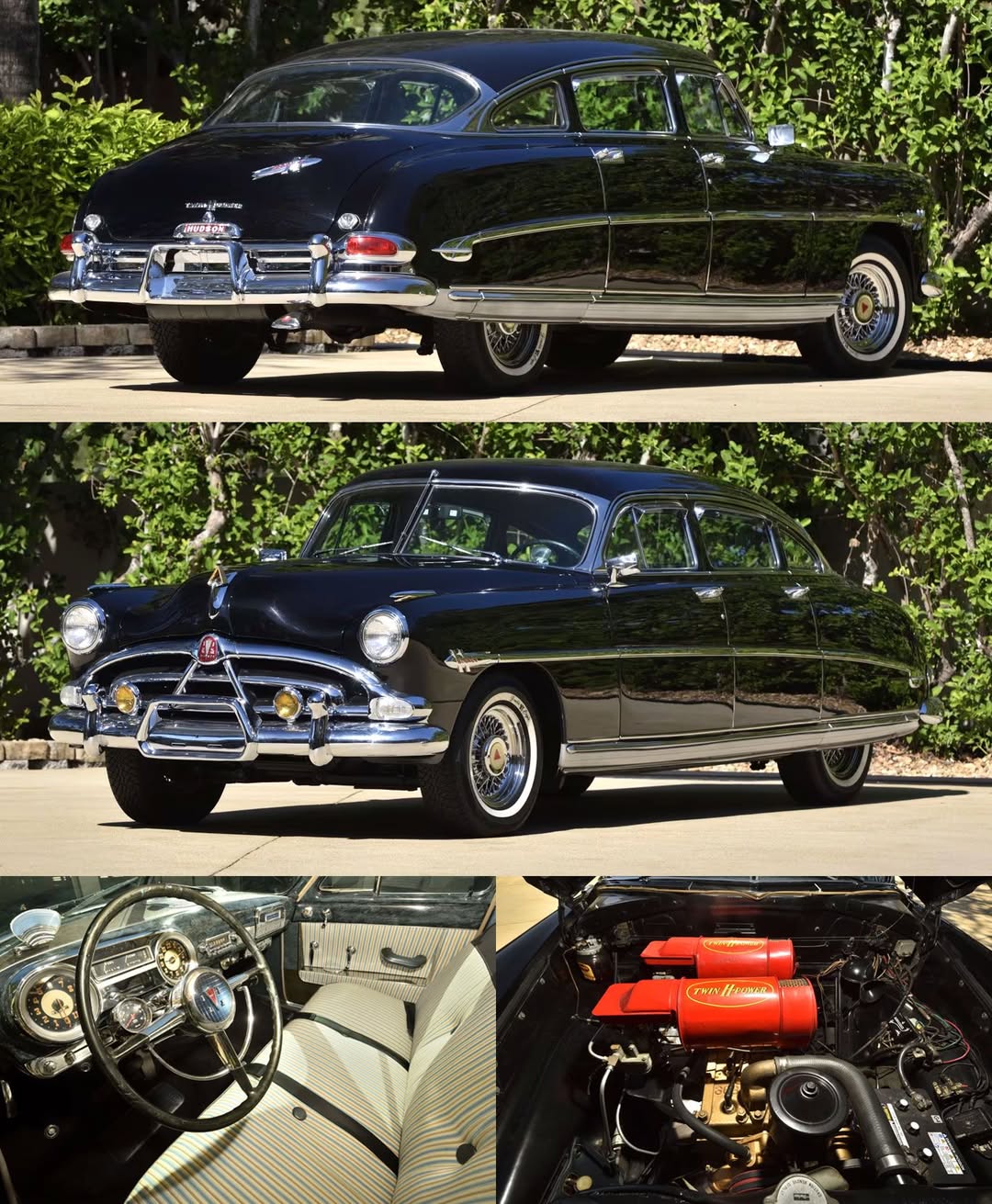
Source