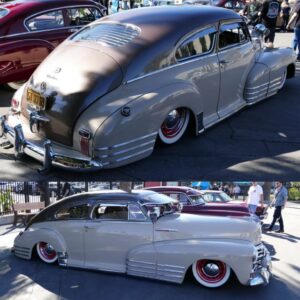
1948 Packard Eight Station Sedan
Packard’s 22nd Series introduced this distinctive Station Sedan for 1948, marketing the model as combining sedan comfort with station wagon utility.
Built by Briggs Manufacturing Company through an innovative adaptation process, standard four-door sedan bodies received modified rooflines, semi-fastback profiles, and decorative wood treatments.
Northern birch framing supported ash and maple panels that were primarily ornamental rather than structural, with the two-piece tailgate being the only functional wood component. This pioneering tailgate design would influence American wagon construction throughout the 1950s.
The New York Fashion Academy recognized the Station Sedan as “Fashion Car of the Year” for 1948, acknowledging its Art Deco styling elements including fender skirts and the signature Cormorant hood ornament.
Six-passenger seating capacity placed it between traditional sedans and larger family wagons, while equipment drawn from the Deluxe Eight line included a clock, trip odometer, and courtesy lighting.
Power came from Packard’s 288 cubic inch L-head inline-eight engine producing 130 horsepower at 3,600 rpm, paired with a three-speed manual transmission featuring optional overdrive for relaxed highway cruising.
Production totaled just 3,865 examples from 1948 through 1950, with most built during the inaugural 1948 model year.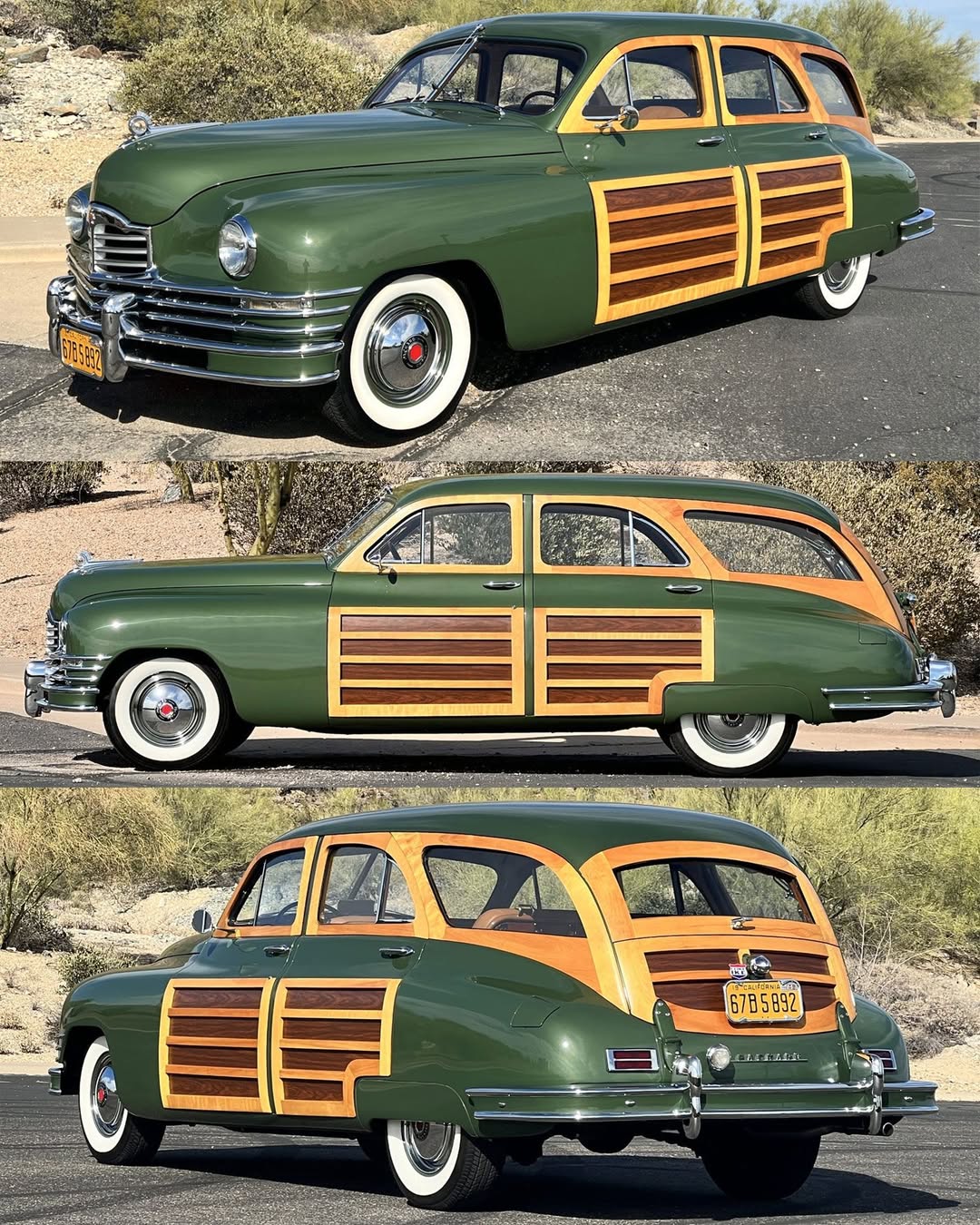
Source