1932 Cord L-29 Cabriolet
Front-wheel drive arrived in American production automobiles with this Auburn-built luxury car introduced in 1929.
Engineer Cornelius Van Ranst adapted Harry Miller’s Indianapolis race car principles to create a passenger vehicle with the Lycoming straight-eight mounted ahead of the front axle, followed by the clutch, three-speed transmission, and differential.
This configuration eliminated the driveshaft tunnel and allowed a dramatically lower profile than conventional designs, with sedan height measuring just 61 inches. The cabriolet body style showcased this low-slung silhouette particularly well.
Power came from a side-valve inline eight initially displacing 298 cubic inches and producing 125 horsepower. From mid-1931 forward, displacement increased to 322 cubic inches with the improved “FF” engine, which featured a larger bore, revised internal details, and output of approximately 140 horsepower.
The 137.5-inch wheelbase supported quarter-elliptical front leaf springs (paired on each side) and rear semi-elliptical springs, with four-wheel hydraulic drum brakes providing stopping power.
Despite innovative engineering and pricing around $3,000, the Depression devastated sales. Production ended in early 1932 after approximately 4,429 units were built across all body styles.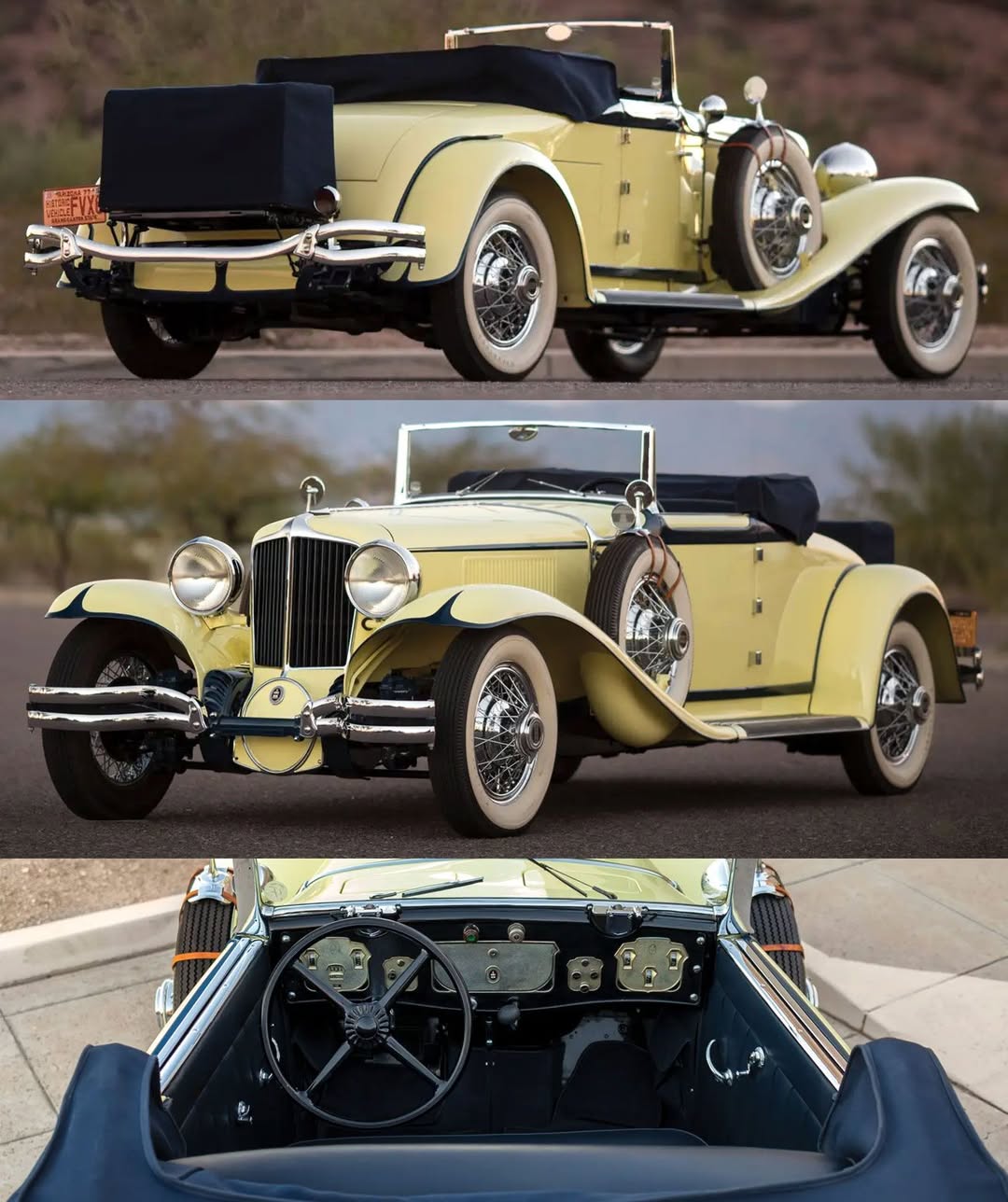
Source