1922 Duesenberg Model A Touring
Fred and August Duesenberg translated their racing success directly into one of America’s first series-production automobiles powered by a straight-eight engine, and the first such U.S. production car to pair that layout with four-wheel hydraulic brakes.
Introduced at the end of 1920 in New York but not built in quantity until 1921, the Model A combined advanced engineering with sophisticated coachwork, firmly establishing the brothers’ reputation for building exceptional passenger cars.
Indianapolis coachbuilder Millspaugh & Irish bodied many Model A examples, supplying sedan and touring designs alongside custom work from builders like Fleetwood and Brunn, with the touring configuration typically mounted on the standard 134-inch wheelbase ladder frame using aluminum panels over a wood framework.
Racing experience informed every major mechanical element. The 260-cubic-inch (4.3-liter) single-overhead-cam straight-eight produced about 88 horsepower at 3,600 rpm in standard tune, using hemispherical combustion chambers and crossflow breathing through a single updraft carburetor.
Four-wheel hydraulic brakes with finned aluminum front drums were an industry first for an American series-production automobile, arriving years before any of the major U.S. manufacturers offered similar technology.
Approximately 600 to 650 Model As were built between 1921 and 1926, when E. L. Cord gained control of the company. Despite limited production compared to mass-market automobiles, the Model A clearly demonstrated the engineering capability that would later define the legendary Model J.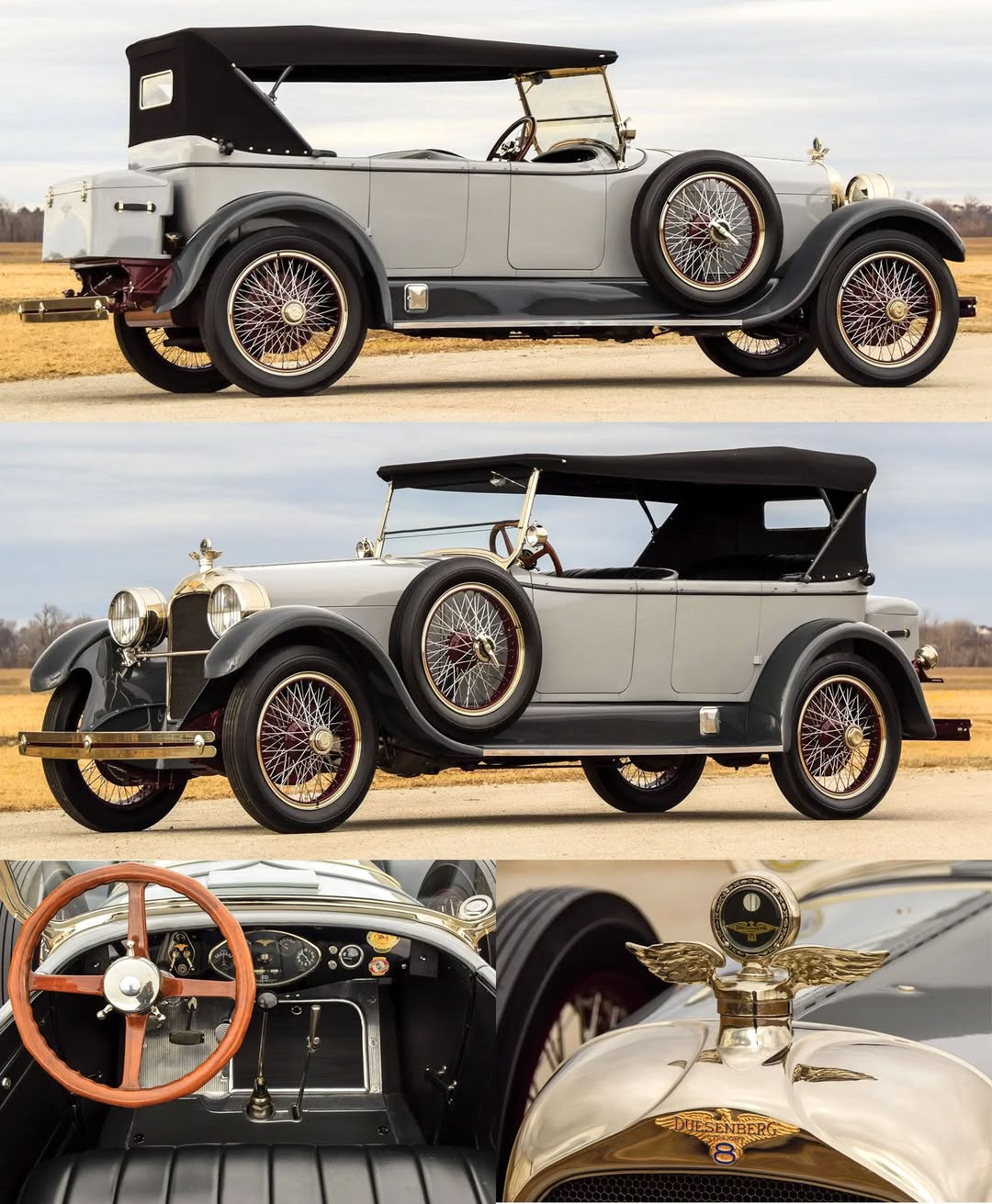
Source