1939-40 Aston Martin Atom Concept Car
Completed in 1940 shortly after the Dunkirk evacuation, the Aston Martin Atom was a one-off factory prototype that previewed the company’s postwar direction.
It used an advanced integral chassis of box sections and tubes carrying lightweight aluminum body panels, an approach that anticipated later spaceframe-style sports cars by more than a decade.
The Atom’s streamlined four-door fastback saloon body rode on a compact chassis with a wheelbase of roughly 102 inches, featuring coil-spring independent front suspension built around an Armstrong-patented layout.
A French Cotal four-speed electromagnetic pre-selector gearbox provided clutchless shifting, giving the car unusually refined and sophisticated manners for a prewar British prototype.
Power first came from a 2.0-liter four-cylinder derived from Aston Martin’s existing 15/98 engine, later replaced during the war by Claude Hill’s 1,972 cc overhead-valve four with twin SU carburetors.
Even on wartime-grade fuel the Atom was capable of about 90 mph, matching its brief from company head Gordon Sutherland to be the smallest, lightest, quietest enclosed saloon possible while preserving genuine sports car handling.
Civilian car production and registrations in the UK were heavily restricted from 1940 onward, which meant the Atom remained a unique experimental car rather than a showroom model. Its structural ideas, independent front suspension, and compact 2.0-liter powertrain program fed directly into Aston Martin’s first postwar “DB” models.
Industrialist David Brown tested the Atom when he was evaluating Aston Martin as a potential acquisition. Impressed by its performance and engineering sophistication, he went on to purchase the company in 1947, setting the stage for the celebrated DB-series sports cars that would define Aston Martin in the 1950s and 1960s.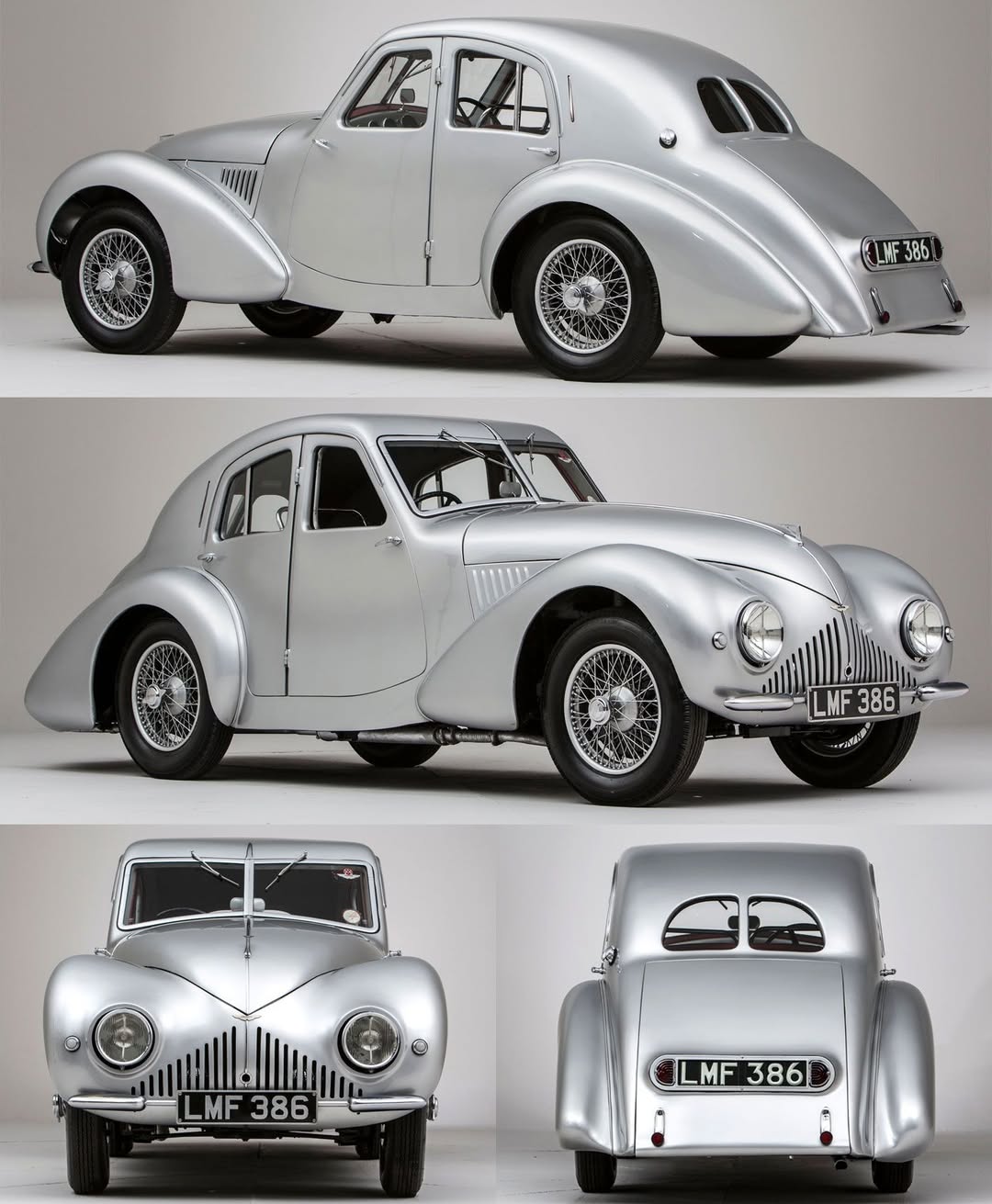
Source