1965 Citroën DS 19 Cabriolet
With total factory production of 1,365 units across its entire run from 1960 to 1971, the DS Cabriolet occupies a distinct position among postwar French coachbuilt cars (produced in small enough numbers to be genuinely rare, yet carrying the engineering substance of one of the most technically advanced automobiles of its time).
The conversion was the work of Henri Chapron, whose Levallois-Perret coachworks handled the transformation under an arrangement that gave the finished cars official factory status and distribution through Citroën dealers.
Chapron built the cabriolets on a reinforced platform derived from the DS sedan structure (rather than the ID Break estate), providing the structural foundation needed once the standard roofline was removed.
Flaminio Bertoni’s original body language translated well to the open configuration, with the low, sweeping silhouette retaining much of the closed car’s visual character.
Beneath the bodywork, the DS’s hydropneumatic self-leveling suspension remained fully intact, along with its power-assisted brakes and hydraulically assisted clutch and semi-automatic transmission (power steering was also hydraulically assisted).
The DS 19 designation indicated the original 1,911cc overhead-valve inline four-cylinder engine, a long-stroke unit that Citroën replaced with a revised 1,985cc version for the DS 20 beginning in the 1966 model year. A four-speed manual gearbox was available in certain markets, though most were equipped with Citroën’s hydraulically controlled semi-automatic transmission.
Chapron also continued building his own independent convertible conversions outside the usine cabriolet program, producing approximately 389 additional examples (including Croisette and Palm Beach variants) through 1973.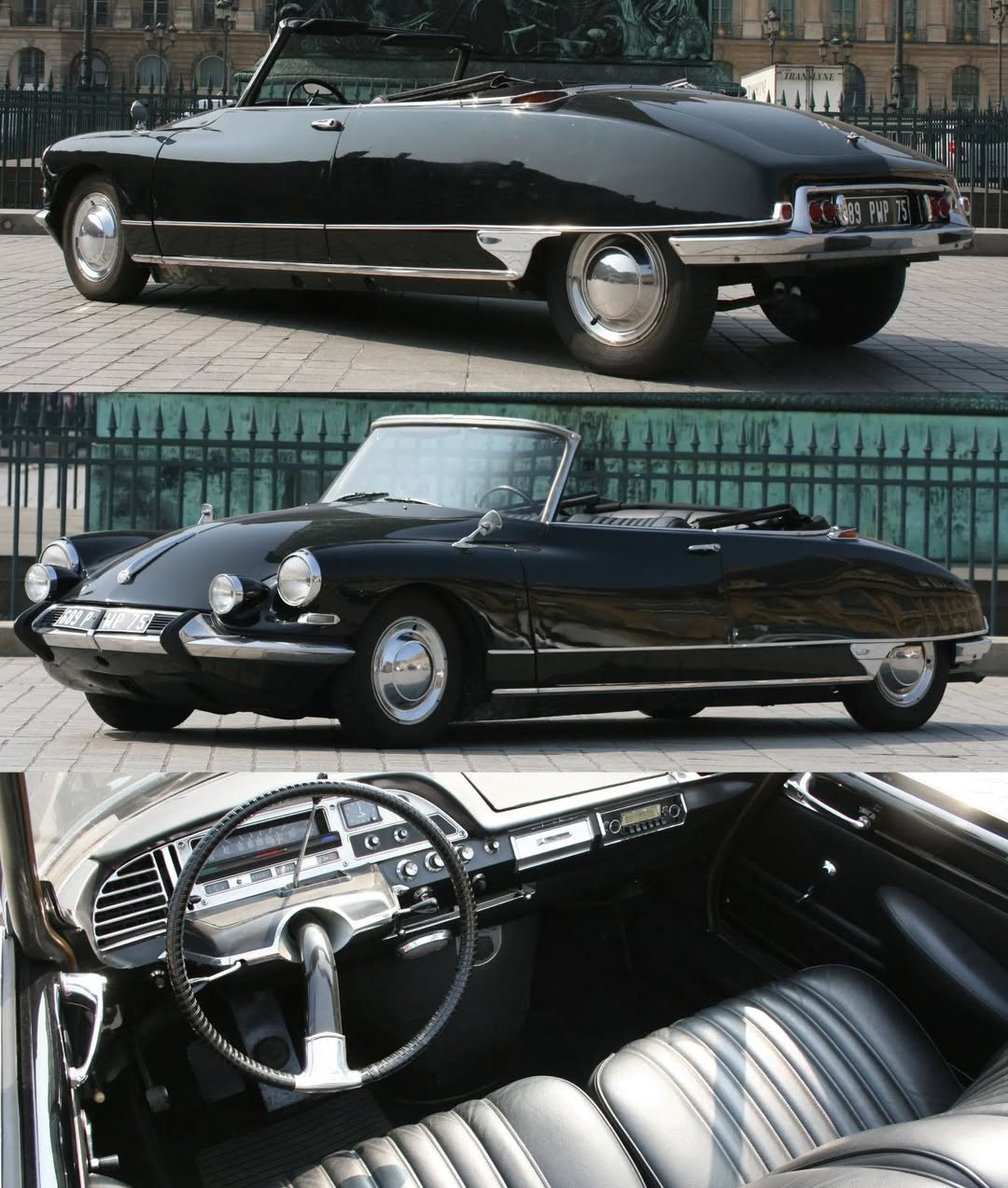
Source