1952 Cunningham C3 Coupe
Briggs Cunningham (heir to the Swift meatpacking fortune and determined to win at Le Mans with American machinery) set out to build a sports car that could stand toe to toe with Europe’s best while retaining a distinctly American identity.
The result was the Cunningham C3, a road-going version of his competition chassis that combined Italian coachwork with modified Chrysler FirePower V-8 power. It effectively bridged the gap between contemporary European sports cars and emerging American performance, offering Ferrari-level pace wrapped around proven Detroit mechanicals.
Le Mans homologation rules for 1952 required at least 25 production cars, and the C3 was Cunningham’s answer to that challenge.
Giovanni Michelotti penned the design for Turin’s Carrozzeria Vignale, which hand-built aluminum and steel bodies featuring Ferrari-influenced proportions scaled roughly 20 percent larger. The flowing coupe and cabriolet forms featured restrained brightwork and two- or three-tone paint schemes over leather-trimmed interiors.
Production proved challenging, as Cunningham’s West Palm Beach facility could assemble roughly one chassis per week while Vignale required close to two months per body. Rolling chassis were shipped to Italy for coachwork before returning to Florida for final finishing.
The 331 CI Chrysler FirePower V-8 received custom aluminum intake manifolds mounting four Zenith single-barrel carburetors, raising output to about 220 HP from the stock 180 HP rating. Early examples used three-speed Cadillac manual transmissions, while later cars received Chrysler’s semi-automatic Fluid-Torque unit.
Performance included 0-60 mph times around 7 seconds and top speeds approaching 135 mph. Production concluded after approximately 25-27 examples at prices near $10,000, making these the only Cunningham automobiles built for public sale.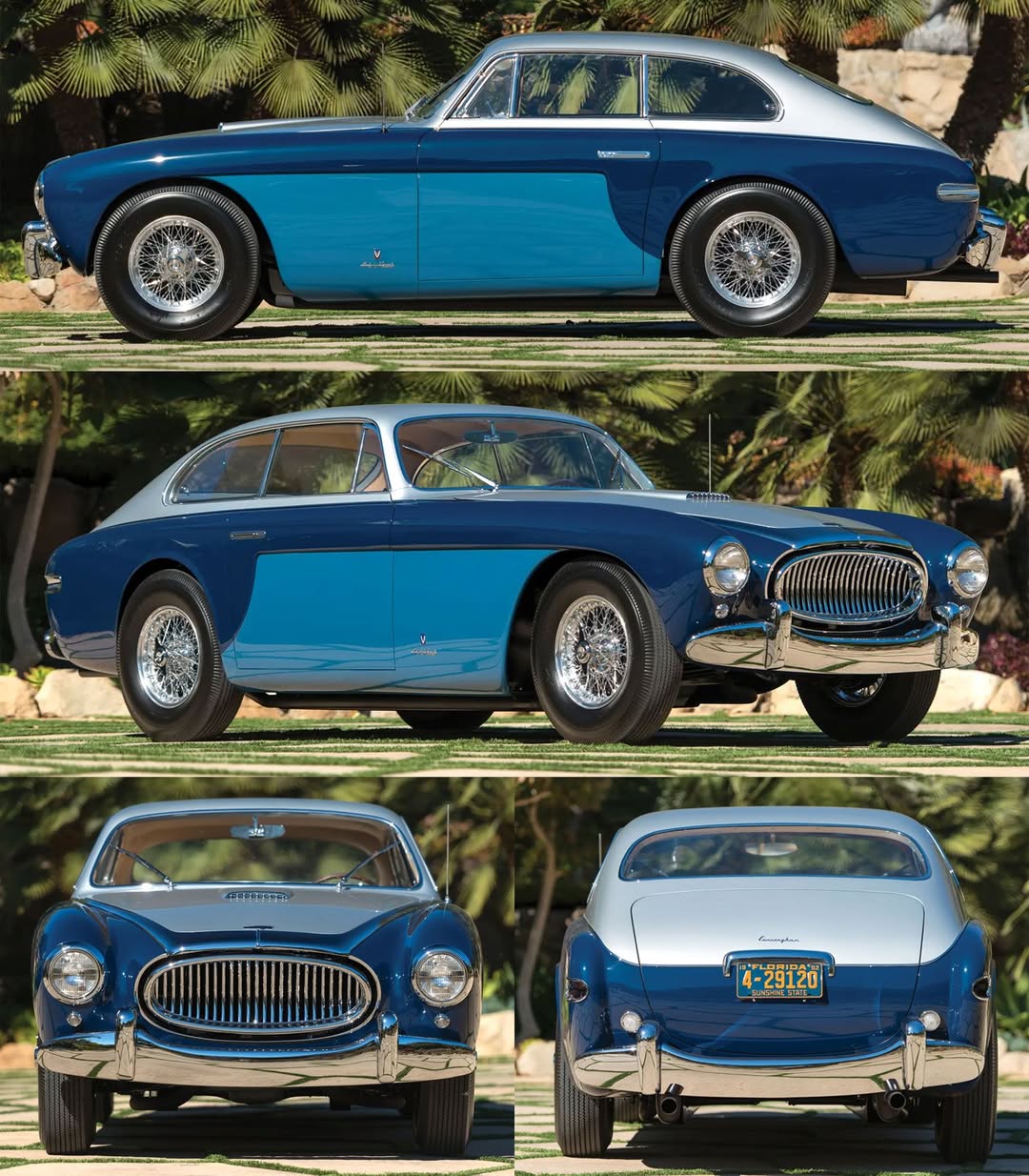
Source