1909 Rolls-Royce 40/50hp Silver Ghost Roi des Belges Tourer
Pre-1910 examples represent the most sought-after segment of Silver Ghost production, their rarity influenced in part by early attrition and the impact of World War I, when many cars were requisitioned for military service or lost.
The 40/50 h.p. model established Rolls-Royce’s reputation for engineering excellence through highly publicized reliability trials, most notably the 1907 Scottish Reliability Trial, after which Autocar magazine famously referred to it as “The Best Car in the World.”
The Roi des Belges body style featured elevated rear seating and gracefully curved rear bodywork, a form popularized by Belgian King Leopold II and first associated with a Panhard et Levassor commissioned for the Belgian court.
This touring configuration became fashionable on high-end European chassis before World War I, as the raised rear seats offered rear passengers excellent visibility and a sense of occasion.
The side-valve inline six-cylinder engine displaced 7,036 cc in early form, increasing to 7,428 cc from 1910. Output was nominally rated at 40/50 horsepower, with actual power estimated at around 50 horsepower.
Power was transmitted through a four-speed manual gearbox, while a three-speed unit was used on some of the earliest cars before the four-speed became standard. Semi-elliptic leaf springs at all four corners contributed to the refined ride quality that became synonymous with the Rolls-Royce name.
Production of the 40/50 h.p. Silver Ghost ran from 1907 through 1925, with 6,173 chassis built in Britain and a further 1,703 produced in Springfield, Massachusetts.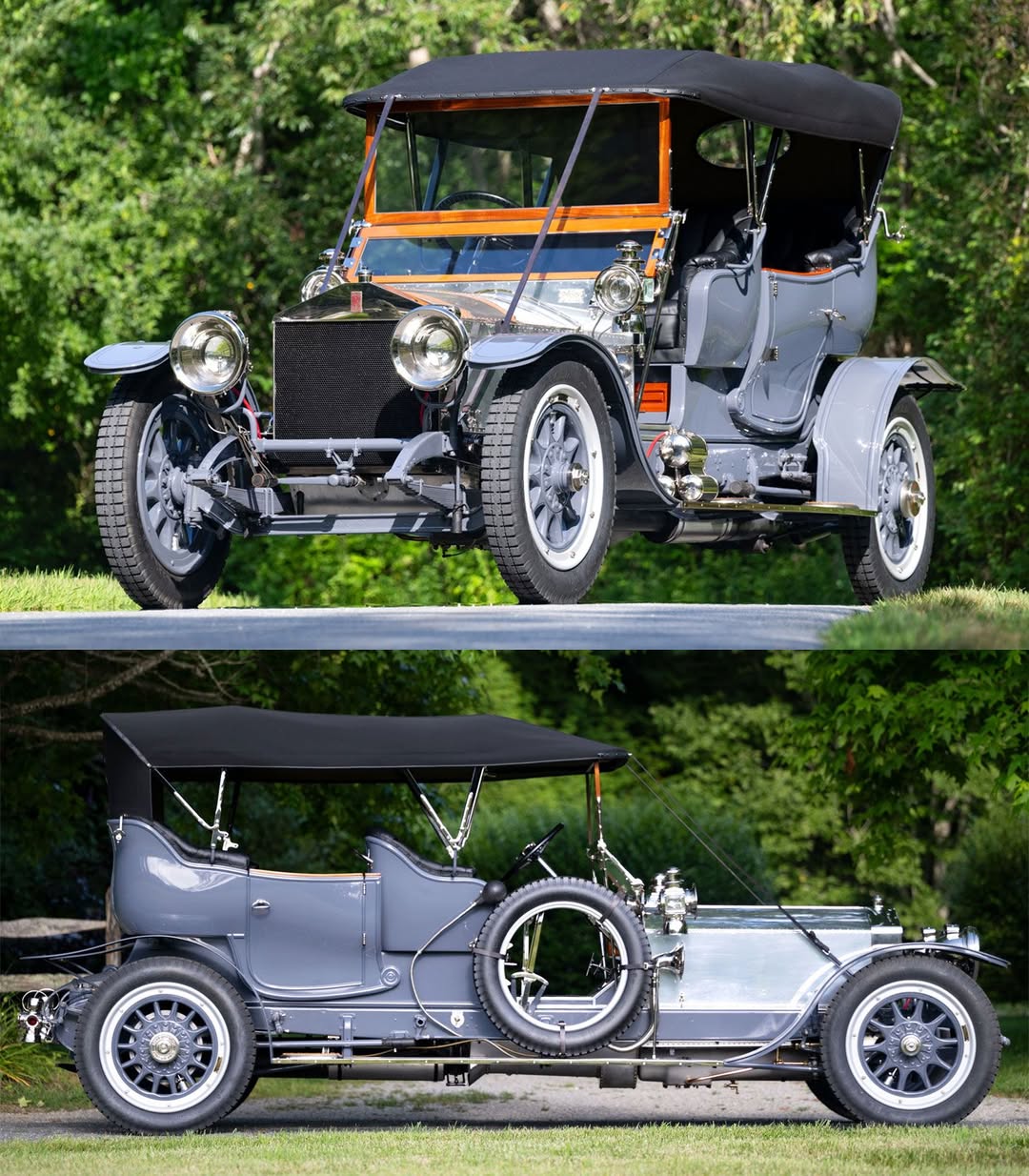
Source