1970 Renault 8
Philippe Charbonneaux’s angular design departed sharply from Renault’s earlier rounded forms when the 8 replaced the Dauphine in 1962.
The boxy four-door sedan retained its predecessor’s rear-engine configuration on an 89.4‑inch wheelbase, but flat panels and sharp creases reflected changing European styling preferences.
This architectural approach continued through 1970, by which point the model faced replacement by the front-wheel-drive 12 in France, though production would persist in Spain until 1976 and Romania manufactured licensed Dacia 1100 versions through 1972.
Renault offered escalating performance levels across the range.
Standard French models used a 956 cc (about 58 cubic inches) Cléon-Fonte four-cylinder producing 44 horsepower, while the 8 Major stepped up to an 1,108 cc (about 68 cubic inches) engine with 50 horsepower.
The R8 Gordini introduced in 1964 used a specially tuned 1,108 cc engine rated at about 90-95 horsepower, and in 1967 the updated R1135 Gordini gained a 1,255 cc engine rated at 100 horsepower and adopted quad headlamps that visually distinguished it from lesser variants.
Engineer Amédée Gordini also specified a close‑ratio five-speed manual gearbox for the later 1,255 cc Gordini models, a feature not offered on standard R8s.
The rear-mounted Cléon-Fonte engines incorporated sealed-for-life cooling systems pioneered on Renault’s earlier models, effectively eliminating routine coolant top-ups under normal conditions.
Rally competitors found considerable success with Gordini versions in European events throughout the 1960s, cementing the Renault 8 Gordini’s reputation as an affordable, rear‑engined sports sedan.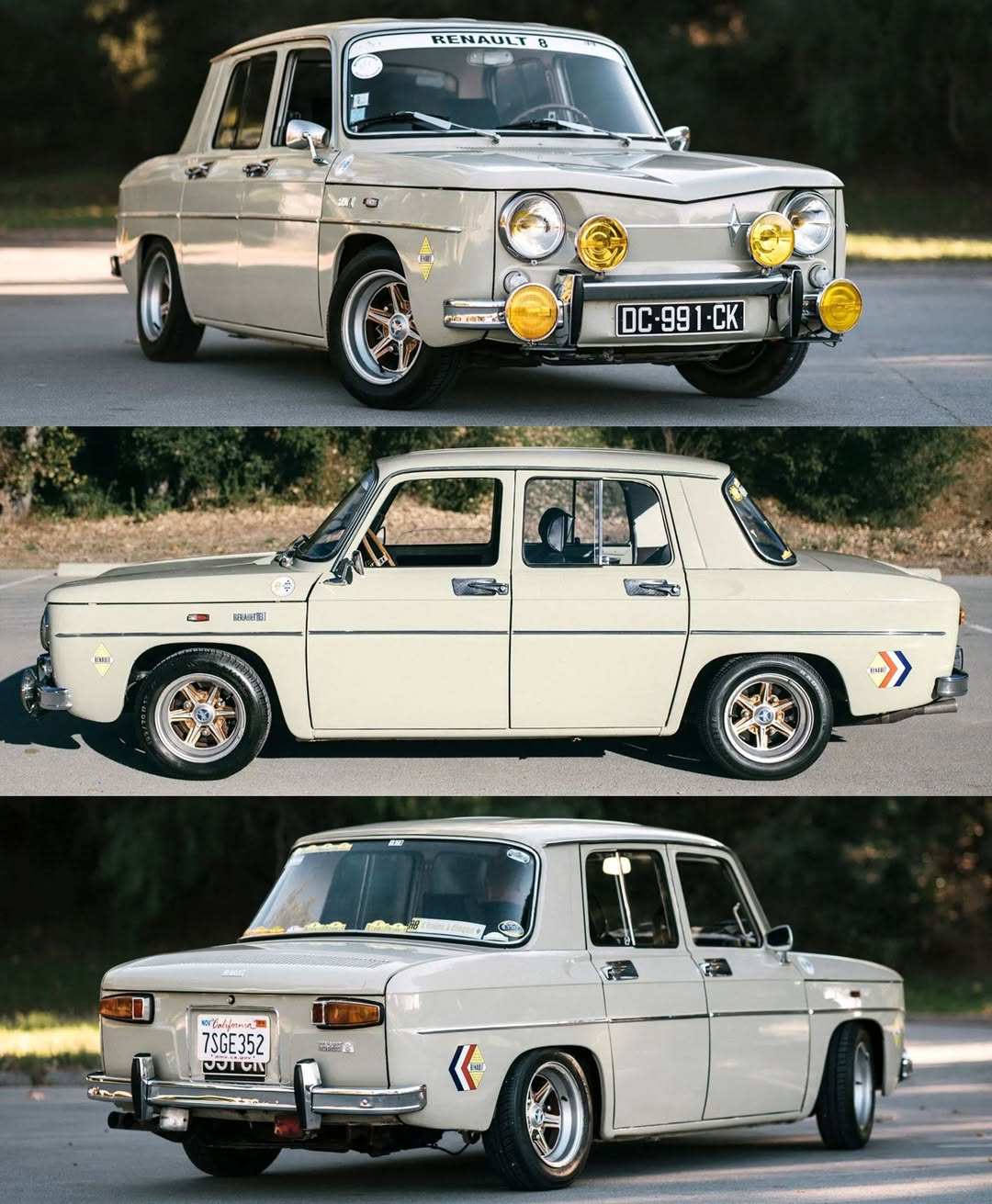
Source