1967 Ford Mustang Shelby GT500 Super Snake
A Goodyear tire test in February 1967 gave Carroll Shelby the opportunity to build what would become the most powerful Mustang of the era.
Former Shelby American Sales Manager Don McCain proposed building a supercar that would outperform anything else in the world, suggesting a 427-powered GT500 prototype for a planned 50-unit production run through Mel Burns Ford.
Chief engineer Fred Goodell selected GT500 No. 544 and fitted it with one-off chrome inboard headlight surrounds and a unique Le Mans stripe pattern (two narrow blue stripes flanking a wide blue center stripe).
Shelby 10-spoke aluminum wheels mounted 7.75-15 Thunderbolt whitewall tires, overinflated with nitrogen to prevent sidewall flex and overheating during high-speed testing.
The lightweight 427 racing engine produced roughly 600 HP, essentially the same powerplant that had won Le Mans the previous year in the GT40 Mk II.
Aluminum heads, an aluminum water pump, a forged crankshaft, and Le Mans-spec connecting rods enabled sustained 6,000 RPM operation. A variation of the Mk II’s “bundle of snakes” exhaust system completed the package, along with an external oil cooler, braided lines, and a remote oil filter for reliability.
At Goodyear’s high-speed facility near San Angelo, Texas, Shelby reached approximately 170 MPH during demonstration laps for journalists from Time and Life magazines. Goodell then completed the 500-mile test at a 142 MPH average.
The skinny Thunderbolts reportedly retained 97 percent of their original tread.
Priced at more than twice a standard GT500’s cost, the Super Snake proved too expensive for the planned production run. The car was sold to Braniff International Airways pilots James Haddon and James Gorman, who installed a 4.11 rear gear for drag racing.
Later owner Richard Ellis conducted a light restoration, locating correct engine compartment components and remarkably finding four new-old-stock Thunderbolt whitewalls in an Akron warehouse.
Only one Super Snake was built, making it the rarest Shelby Mustang ever produced.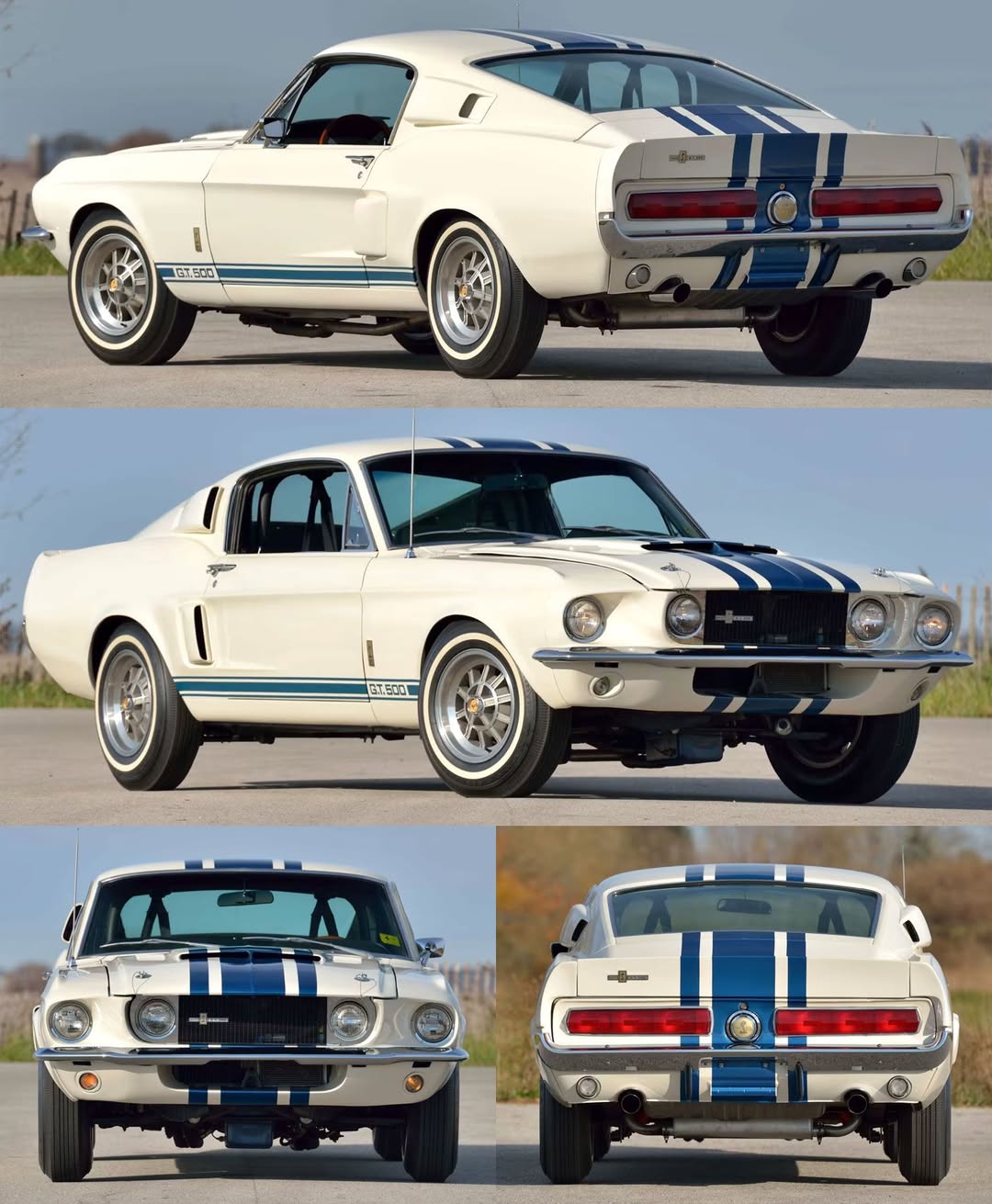
Source