1987 BMW M3
BMW created the E30 M3 as a Group A homologation special, requiring minimum production numbers to qualify for touring car racing. The strategy proved devastatingly successful.
Within twelve months of its public release, the model claimed major victories across the World Touring Car Championship and national series in Germany, Italy, and elsewhere.
Success continued with European and British titles, along with three consecutive Italian championships (1989-1991) and six straight Japanese Touring Car Championship victories (1988-1993).
Paul Rosche led development of the 140-cubic-inch (2.3-liter) dual-overhead-cam four-cylinder S14 engine, combining a 16-valve aluminum alloy cylinder head derived from BMW’s M1 program with a strengthened iron block based on the M10 architecture.
Bosch fuel injection produced nearly 200 horsepower in European specification, while U.S.-market cars were rated at 192 horsepower due to emissions tuning and a lower compression ratio.
Power was sent through a close-ratio Getrag five-speed gearbox with a dogleg shift pattern and a standard limited-slip differential.
The chassis featured independent front and rear suspension with gas dampers, along with servo-assisted ventilated disc brakes at all four corners. U.S.-spec cars carried additional equipment such as air conditioning and federally mandated impact bumpers, raising curb weight to approximately 2,950 lb compared to about 2,700 lb for European versions.
Despite the added weight, these track-derived fundamentals gave the E30 M3 exceptional driving dynamics and have made it the most collectible M3 generation nearly 40 years after its introduction.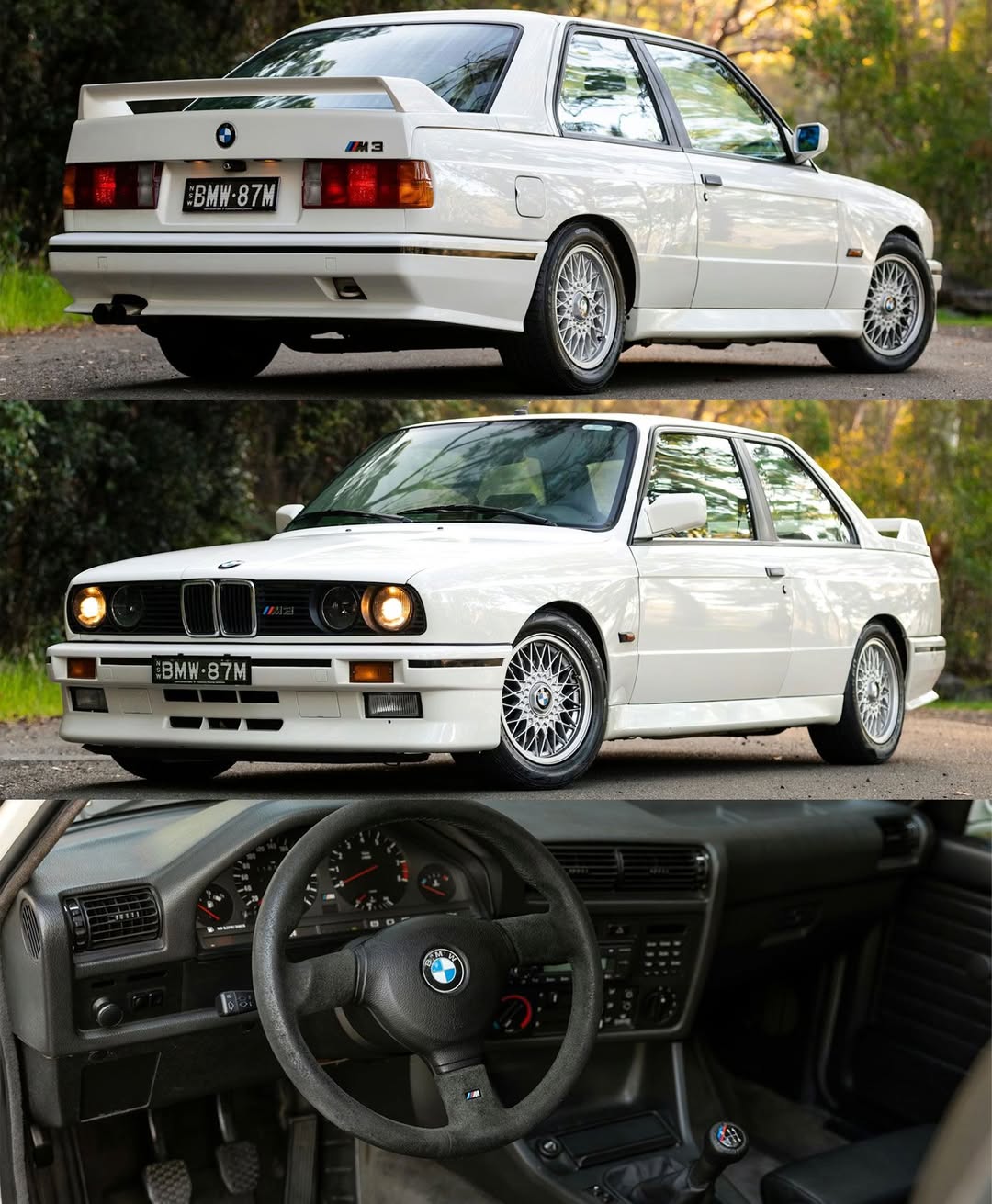
Source