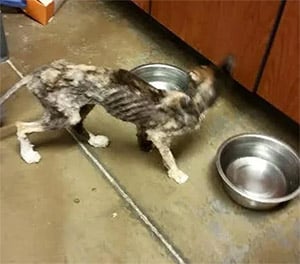
The call came on an ordinary, quiet day.
A message popped up from someone I didn’t know well. Her words were short, urgent, almost trembling through the screen: There’s an injured cat in a garbage bin. I think she’s dying. Can you come?
I didn’t ask many questions. I grabbed my rescue kit—the same worn bag I keep ready by the door—and ran.
The air outside was biting cold. The kind of cold that creeps through your sleeves and settles into your bones. As I drove, I tried to prepare myself. In rescue work, you learn that not every story ends the way you hope.
But I also know that sometimes, showing up makes all the difference.
When I arrived, the woman led me to the back of an alley lined with trash bins. The smell of damp cardboard and old food hung in the air. She pointed silently.
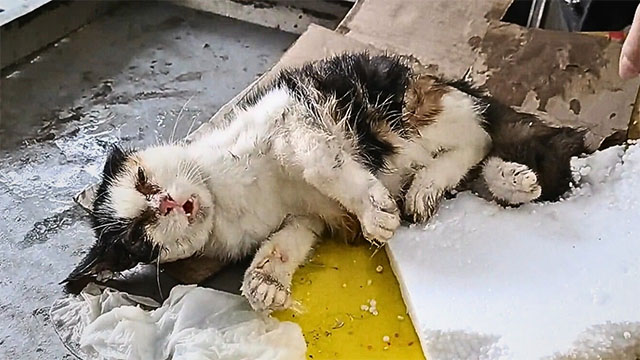
Inside one of the bins, buried under bits of foam and debris, lay a cat.
At first, she didn’t move.
She was curled awkwardly, her body half-hidden under broken pieces of packaging. Her fur was dirty and stiff. For a moment, I thought she might already be gone.
Then I saw her chest rise—barely.
She looked as if she had given up. No cries. No struggle. Just quiet surrender.
I gently began removing the foam that covered her. As light reached her face, something shifted. Her eyes opened wider. And then, from somewhere deep inside her fragile body, she let out a cry.
It wasn’t loud.
It wasn’t strong.
But it was a plea.
The cold weather had likely drained what little strength she had left. I had no idea how long she’d been there. Hours? Days?
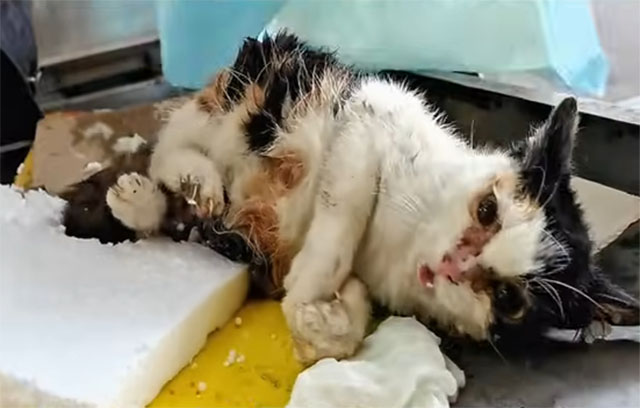
When I looked closer, my heart clenched.
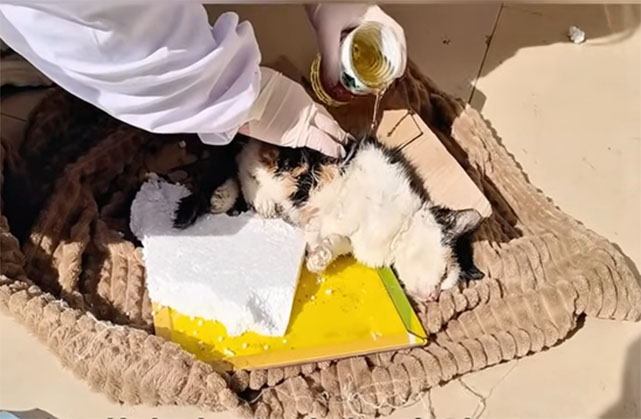
Her back was firmly stuck to a glue trap. Thick adhesive clung to her fur, and pieces of foam were glued underneath her body, completely restricting her movement. Every attempt she must have made to escape had only trapped her further.
I spoke to her softly as I worked. “It’s okay. I’m here now.”
Carefully, I cleared away the loose debris around her. I covered her with a pad I had brought, trying to give her a small sense of security before attempting to lift her.
But the glue trap wouldn’t budge.
It had fused to her fur so tightly that removing it on the spot would have caused unbearable pain. So I did the only thing I could: I lifted her together with the trap and cardboard still attached.
Even that small movement made her cry out again.
I placed her temporarily on top of the garbage bin to adjust my grip. When I finally held her in my arms, she seemed to understand. Her cries changed. They were no longer silent whimpers of resignation—but raw, desperate sounds of a creature who realized she might live.
I whispered to her, wiping moisture from her face with the pad. I brought a blanket from my car and wrapped it around her small, trembling body. She was so light it felt like holding a bundle of fragile sticks.
“If it’s just the glue,” I told myself, “she’ll survive.”
But she was frighteningly weak. The cold and hunger had taken a toll.
We rushed to the animal hospital.
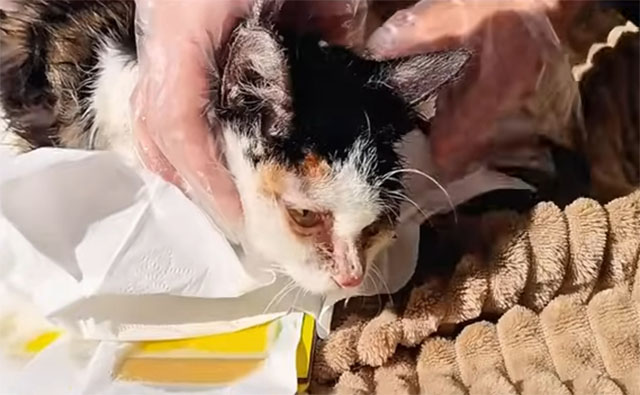
The moment we arrived, I hurried inside and explained everything to the doctor. The cat—still crying softly—looked at us with wide, exhausted eyes. I grabbed tissues and gently wiped the tears collecting at the corners of her face. Whether they were from pain or fear, I couldn’t tell.
We found an electric heating pad and placed her on it immediately. Her body needed warmth as urgently as it needed freedom.
Because removing glue takes time, the doctor chose a bright, sunny corner of the treatment room. Sunlight streamed in through the window, warming the space in a quiet, hopeful way.
The doctor began pouring vegetable oil over the hardened glue. Oil is often the safest way to dissolve adhesive without damaging the skin. I assisted carefully, holding her steady and whispering reassurance.
Little by little, the glue loosened.
After what felt like hours—but was likely just minutes—we managed to separate her from the worst of it.
She was free from the trap.
But our work had only just begun.
The doctor applied oil to a soft pad and asked me to gently place her on top of it, allowing the remaining adhesive to soften further. As we examined her body more closely, we noticed something else—her spine looked abnormal. A bone protruded slightly.
Her belly was also enlarged.
The doctor explained that because her lower body had been stuck, she likely hadn’t been able to defecate. The pressure inside her abdomen was building. It was possible she had been trapped for several days.
Several days.
In the cold.
Unable to move.
Unable to relieve herself.
And likely surviving by eating scraps from the garbage around her.
The thought made my chest ache.
She was extremely thin. The protruding bone may have fractured during her desperate attempts to escape. There was also concern about possible internal bleeding. An X-ray would be necessary.
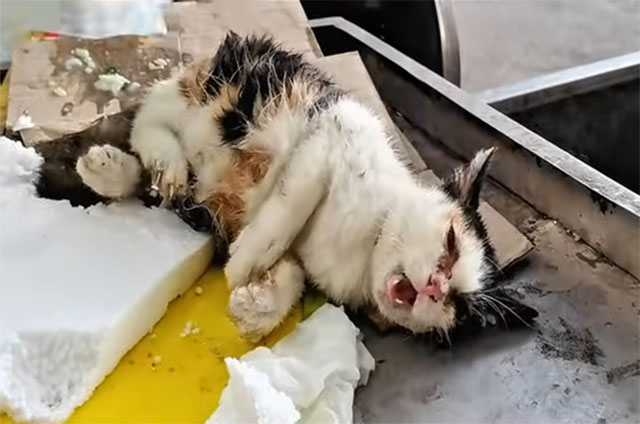
Before that, I offered her a small cat treat. She sniffed it hesitantly—then ate. Slowly at first, then with more determination.
That small act—eating—felt like a victory.
The doctor brought flour and more vegetable oil to continue working the glue out of her fur. The room was warm, and for the first time, her body began to relax.
Incredibly, she fell asleep.
Right there on the table.
Perhaps it was the warmth. Perhaps it was the relief of no longer being stuck. Perhaps, for the first time in days, she felt safe.
We prepared warm water for a bath and set up an electric heater nearby. When we gently placed her into the water, she didn’t resist. She didn’t scratch or panic. She simply allowed us to wash away the glue and dirt that had bound her.
Most of the adhesive came off.
Afterward, we carefully dried her fur. Even then, some oil remained, leaving her coat looking damp and uneven. But she was clean. And free.
Next came the X-ray.
The results were bittersweet. Her spine was deformed—but not broken. That was a relief beyond words.
However, she was suffering from megacolon, a severe buildup of feces due to prolonged inability to pass waste. She also had urinary retention, which could quickly become dangerous.
Medication was administered immediately.
Not long after, she finally defecated.
What she passed was dark and foul. The doctor explained that she had likely been eating garbage to survive, and it had affected her internally.
Hearing that nearly broke me. I imagined her, stuck and starving, reaching whatever scraps she could with limited movement.
But we had made it in time.
I arranged for her to stay at the hospital for ongoing treatment.
And I gave her a name: Banban—meaning “Board”—a quiet nod to the cardboard and trap she had been stuck to for days.
Naming her felt important. It meant she was no longer just “the glue trap cat.” She was someone.
Days passed.
On the seventh day, I returned to visit her.
I barely recognized the fragile creature I had pulled from the garbage bin.
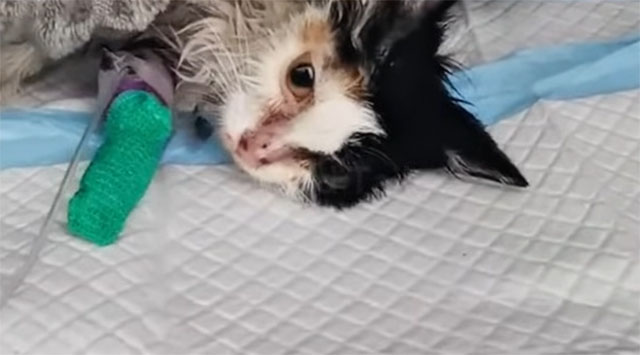
Banban had filled out slightly. Her eyes were clearer. Her breathing steady. Though her spine would require long-term management, her overall condition was stable.
Her megacolon and urinary retention were improving.
The doctor told me that her mental state was getting better too. She had even started taking short walks around her enclosure each day.
I let out a breath I felt I’d been holding for a week.
But when I approached her cage and called her name softly, she shrank back.
She was afraid.
After everything she had endured—trapped, starving, alone—trust would not come overnight. And that’s okay.
Healing isn’t just physical.
It takes time for the body to mend.
It takes even longer for the heart.
There were other animals being discharged that day too—each with their own story of pain and survival. I watched them leave with their caretakers and felt something I always feel in moments like this: gratitude.
Banban’s journey is far from over. Her spine will need careful monitoring. Her digestive health will require continued attention. And earning her trust may take weeks or months.
But she is alive.
She is warm.
She is no longer trapped in glue, waiting silently for the end.
Sometimes people call rescuers “angels.”
I don’t think of myself that way.
The real miracle is simpler than that.
It’s a message sent at the right time.
It’s someone who refuses to ignore a life in need.
It’s a team of doctors working patiently under sunlight.
It’s warmth, oil, water, and steady hands.
Most of all, it’s a small cat who, even after days of suffering, still found the strength to cry out when hope appeared.
Banban’s cry was weak—but it was enough.
And sometimes, enough is everything.