1934 DeSoto Airflow Coupe
The 1934 DeSoto Airflow Coupe was a revolutionary automobile that broke away from conventional styling during the Depression era.
Chrysler’s engineering team extensively tested the Airflow in wind tunnels, creating America’s first truly streamlined production car. The Airflow was designed to reduce wind resistance, validating Chrysler’s claim that it could “bore through the air.”
The coupe’s flowing curves and distinctive “waterfall” grille epitomized the Art Moderne aesthetic, similar to the famous Burlington Zephyr train. Both the Airflow and the Zephyr made their public debuts at the 1934 Chicago World’s Fair, capturing widespread attention for their futuristic looks.
Beyond its striking exterior, the Airflow featured advanced engineering with a steel semi-unitized body structure that was years ahead of its time. Chrysler famously demonstrated this strength by pushing an Airflow off a 110-foot cliff and then driving it away to prove the car’s durability.
Inside, the Airflow featured aircraft-inspired design elements, including seats with exposed chrome tubular frames and cloth upholstery with leather accents.
The coupe model was especially rare, with fewer than 1,600 produced in 1934. Surviving examples are highly sought after by collectors who appreciate this innovative and forward-thinking design.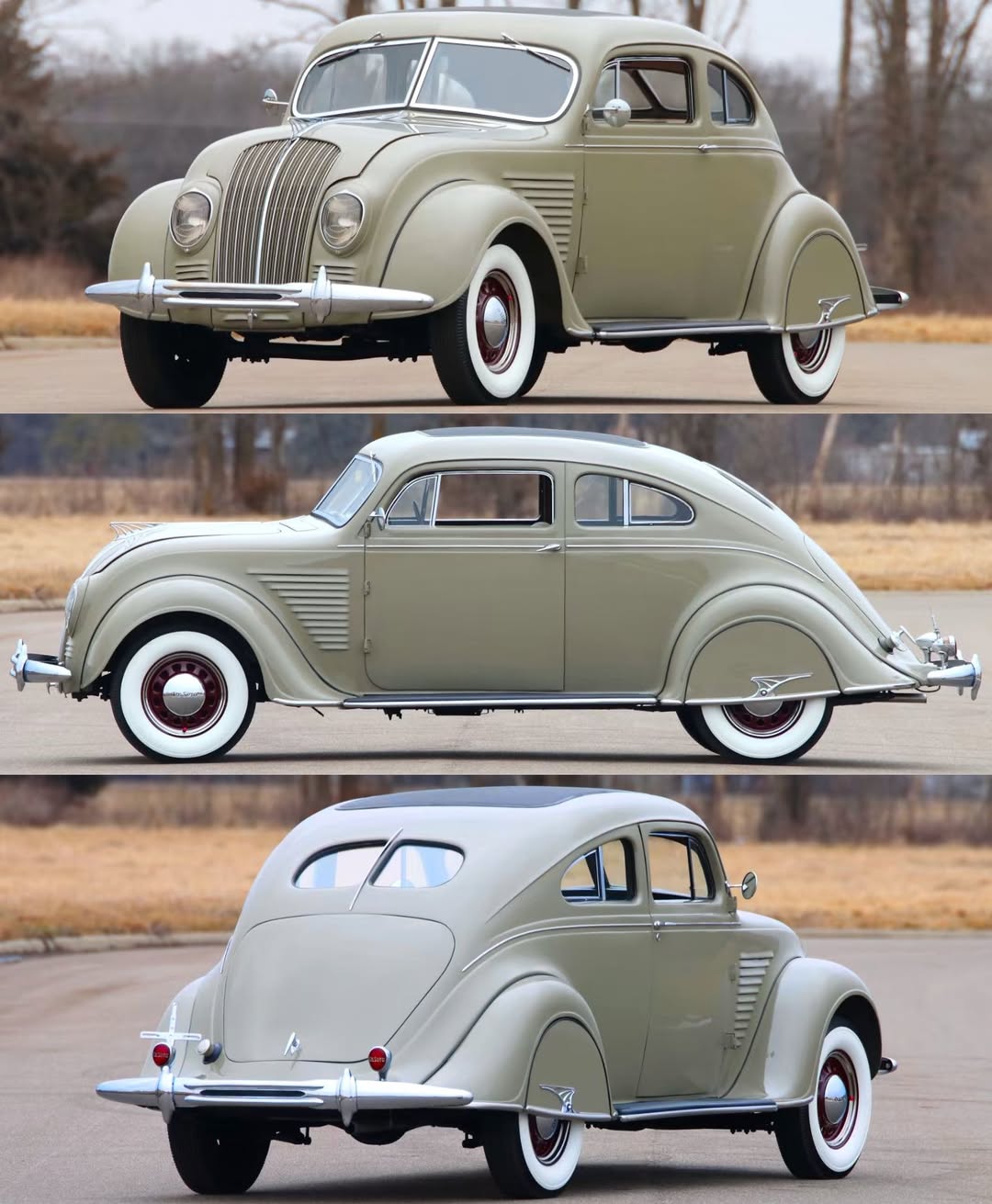
Source