1937 SS 100 Jaguar 2½-Litre Roadster
With its long sweeping cycle fenders, cutaway doors, and aggressive stance on 18-inch wire wheels, the SS 100 ranks among the most visually arresting sports cars of the 1930s.
Built by SS Cars Ltd. in Coventry (the company William Lyons developed from his Swallow Sidecar origins), it was introduced in 1936 and became the first production model to carry the Jaguar name.
The 2½-litre version uses a 2,663 cc inline six-cylinder fitted with an overhead-valve cylinder head developed by Harry Weslake and William Heynes, breathing through twin SU carburetors and producing approximately 100 hp, a considerable improvement over the 68 hp side-valve unit it replaced.
A four-speed gearbox (with synchromesh on the upper three ratios) transmits power to a live rear axle; suspension is by semi-elliptic leaf springs all around. Tested by The Autocar in 1937 with the windshield lowered, the 2½-litre car recorded 95 mph.
Only 191 examples of the 2½-litre were produced before the Second World War ended production, alongside 116 of the subsequent 3½-litre variant.
The SS 100 was among the first models to feature the leaping Jaguar hood mascot, the symbol the marque retained long after the SS name was retired.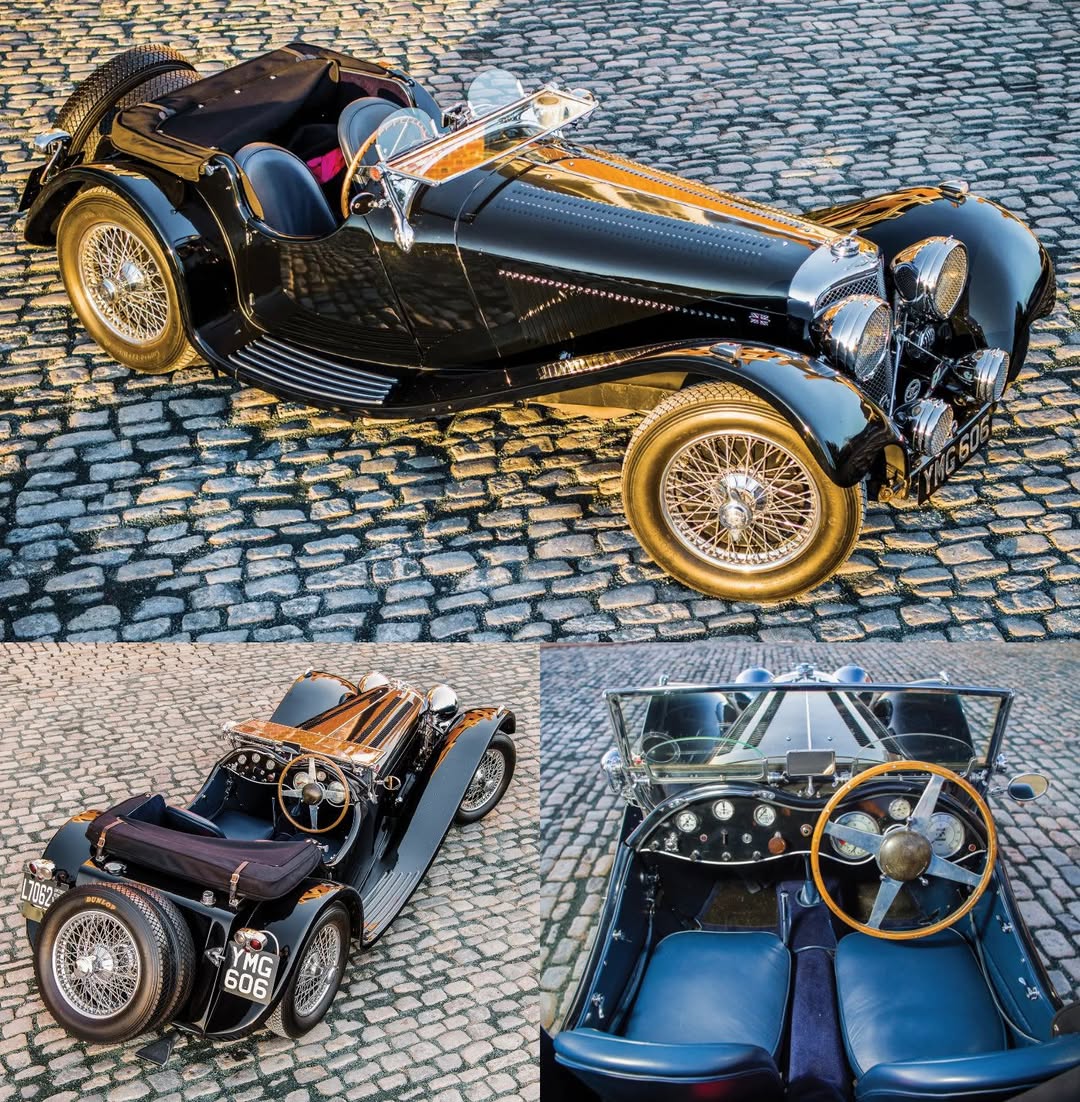
Source