1938 Citroën Traction Avant 11BL Cabriolet
Front-wheel drive technology paired with independent front suspension made this French convertible a standout when it debuted in the 1930s.
The Traction Avant 11B and lighter, shorter-wheelbase 11BL Cabriolet represented two of the rarest configurations of Citroën’s groundbreaking design, with fewer than 600 cabriolets built between 1937 and 1939 (well under 1% of total Traction Avant production).
Built with Citroën’s revolutionary unitary body construction, the 11B and 11BL featured a 1,911 cc four-cylinder overhead-valve engine with wet liners. The advanced chassis incorporated front torsion bar independent suspension, rear torsion bars, and four-wheel hydraulic brakes while most competitors still relied on separate frames, leaf springs, and mechanical brake systems.
The 11B rode on a longer wheelbase than the 11BL (the BL standing for Légère), giving buyers a choice between slightly more interior room or a more compact footprint. Curb weight was approximately 2,650 lbs (1,200 kg) for the 11B Cabriolet and about 2,425 lbs (1,100 kg) for the 11BL Cabriolet.
The convertible body provided an open-air experience of the model’s celebrated handling characteristics and stability, qualities that helped cement the Traction Avant’s reputation across Europe.
Overall Traction Avant production continued through 1957, making it one of the longest-running automotive designs of its era, and its engineering innovations influenced car development for decades afterward.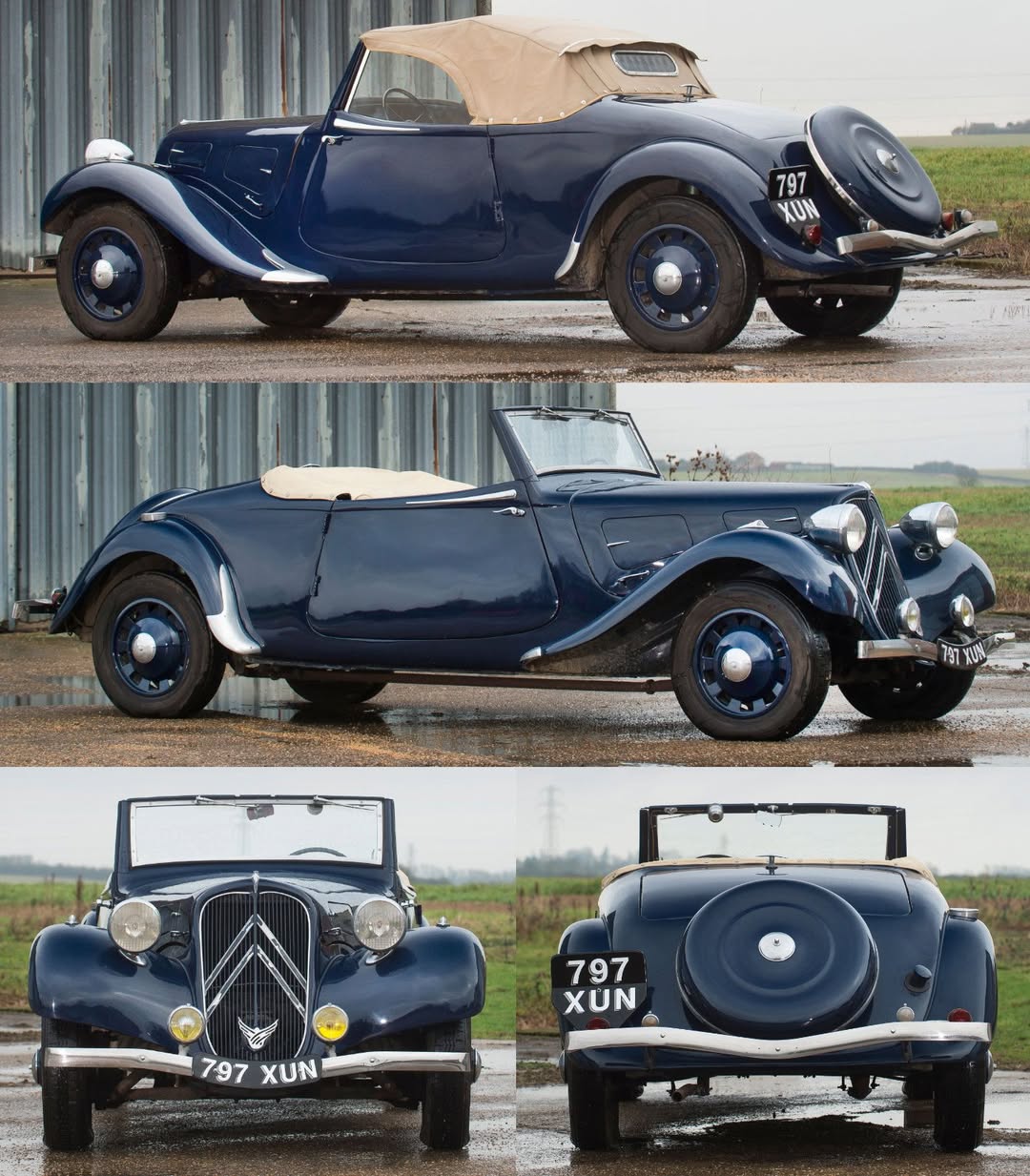
Source