1968 Toyota Land Cruiser FJ40
Toyota’s origins with the Land Cruiser trace back to 1951, when the U.S. Army asked Toyota to produce a light utility vehicle built to Willys Jeep specifications for use during the Korean War. The civilian “Land Cruiser” name followed in 1954, and the FJ40, the model that would define the nameplate for a generation, entered production in 1960.
Slightly larger than the Jeep CJ it was loosely derived from, the two-door FJ40 wore a purposeful, upright body with a removable soft or hard top, fold-flat windshield, and body-on-frame construction. Ground clearance of approximately 8.3 inches and a 90-inch wheelbase kept it maneuverable on tight trails.
Semi-elliptical leaf springs front and rear, combined with live axles, gave it a simple, durable suspension architecture well-suited to sustained hard use.
Power came from Toyota’s F-series OHV inline-six displacing 236 cubic inches (3.9 liters) and producing approximately 125 hp (SAE gross), paired with a three-speed manual and two-speed transfer case for part-time four-wheel drive.
The FJ40 remained in production through 1984 (U.S. sales ended after the 1983 model year), selling in over 100 countries and developing an enduring collector following on the strength of its mechanical straightforwardness and long-term reliability.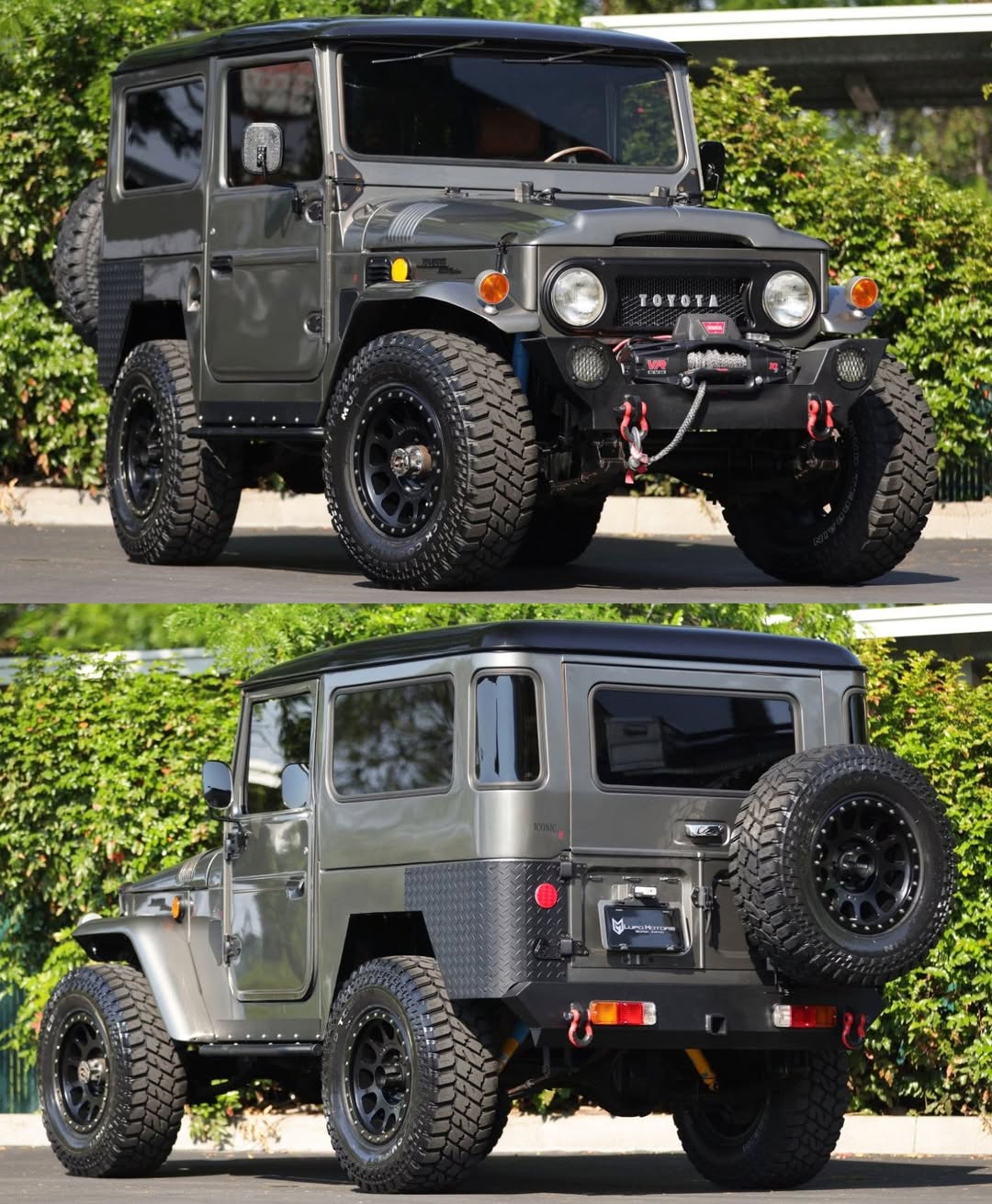
Source