1938 Horch 853 Cabriolet
August Horch’s engineering career began at a marine engine manufacturer in Leipzig before he joined Karl Benz’s motor works in Mannheim. Frustrated with Benz’s conservative design philosophy, Horch established his own company in 1904, favoring front-mounted engines with shaft-driven rear axles (marking the first use of this configuration in Germany).
After a dispute with his board of directors, Horch left the firm that bore his name and went on to found Audi in 1909. In 1932, Audi, Horch, DKW, and Wanderer merged to form Auto Union, whose four-ring emblem endures today as the symbol of Audi.
The 1938 Horch 853 Cabriolet represented the pinnacle of German luxury automobiles in the pre-war era, competing directly with Mercedes-Benz as the nation’s only serious domestic rival in the prestige market.
Introduced in 1935 and refined through 1938, the Type 853 featured Fritz Fiedler’s 4.9-liter straight-eight engine with a single overhead camshaft and nine main bearings, delivering performance of up to 140 km/h (87 mph) through a four-speed manual transmission with an overdrive top gear and servo-assisted hydraulic brakes.
The chassis was notably rigid and well-engineered, providing an ideal foundation for a range of elegant coachbuilt bodies by firms such as Gläser, Erdmann & Rossi, and Voll & Ruhrbeck.
Built under the Auto Union umbrella, the Horch 853 exemplified the group’s commitment to engineering excellence and luxury craftsmanship. Production continued until the outbreak of World War II, with approximately 950 examples completed.
After the war, Horch’s Zwickau factory found itself behind the Iron Curtain in East Germany, where it eventually produced the utilitarian Trabant (a stark contrast to the marque’s earlier reputation as one of the world’s most prestigious luxury car manufacturers).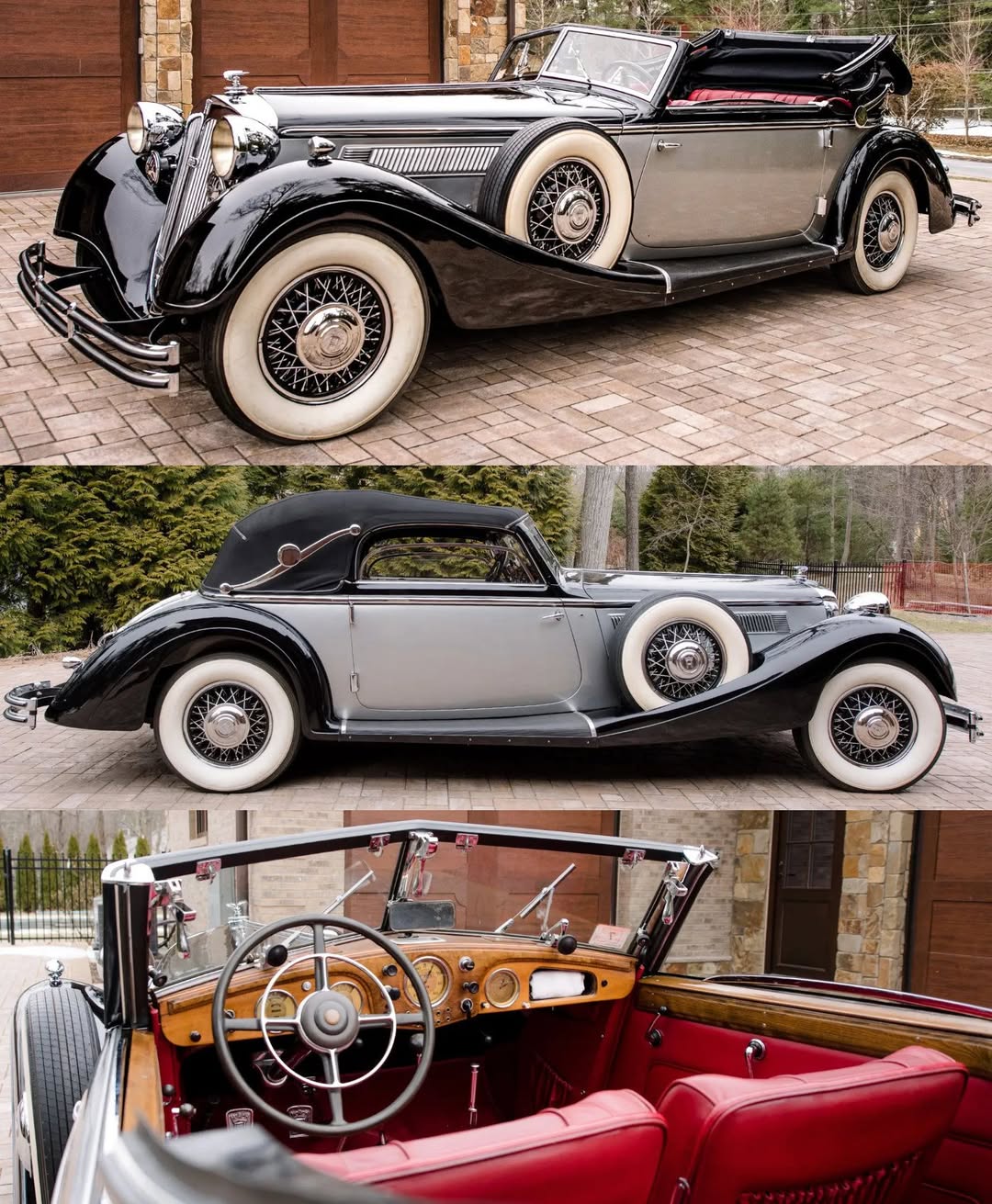
Source