1956 Buick Century
Buick’s performance formula combined the compact Special-based Century body with maximum available V-8 power when the Century nameplate returned for 1954, continuing into the 1956 model year with stronger output and higher cruising speeds than most mid-priced rivals.
For 1956 the Century’s 322-cubic-inch Nailhead V-8 was rated around 255 horsepower in most trim levels, typically paired with Buick’s variable-pitch Dynaflow automatic, and a properly tuned example could reach roughly 110 mph, though absolute top speed varied with axle ratio and body style.
Four-door pillarless hardtop construction (badged Riviera in Buick parlance) was introduced for the 1955 model year and continued for 1956, sharing its general concept with similar GM B-body hardtops across Buick, Oldsmobile, and other divisions.
This body style deleted fixed door pillars while relying on reinforced sills and roof structure, creating an unusually open greenhouse when all side glass was lowered, and it quickly proved popular, although it did not universally outsell conventional four-door sedans in every nameplate and model year.
Built on a 122-inch wheelbase in 1956, the Century occupied Buick’s mid-range slot, above the Special but below the Super and Roadmaster, while still using the division’s top-tier small-displacement V-8 rather than a de-tuned engine.
The vertical-valve “Nailhead” layout gave the V-8 a notably narrow external width for its displacement and emphasized strong low-end and midrange torque, which matched well with the Dynaflow’s torque-multiplying characteristics and Buick’s emphasis on effortless acceleration rather than high-rpm power.
The Century designation has long been associated in Buick lore with the idea of a 100-mph car, reflecting the original 1936 Century’s ability to hit the “century mark,” although the direct naming inspiration is not universally documented as a formal British terminology borrowing.
By the mid-1950s, well-tuned Centurys could surpass 100 mph on suitable roads, a capability still noteworthy at a time when many American family cars were geared more for relaxed 60-70 mph cruising than sustained triple-digit speeds.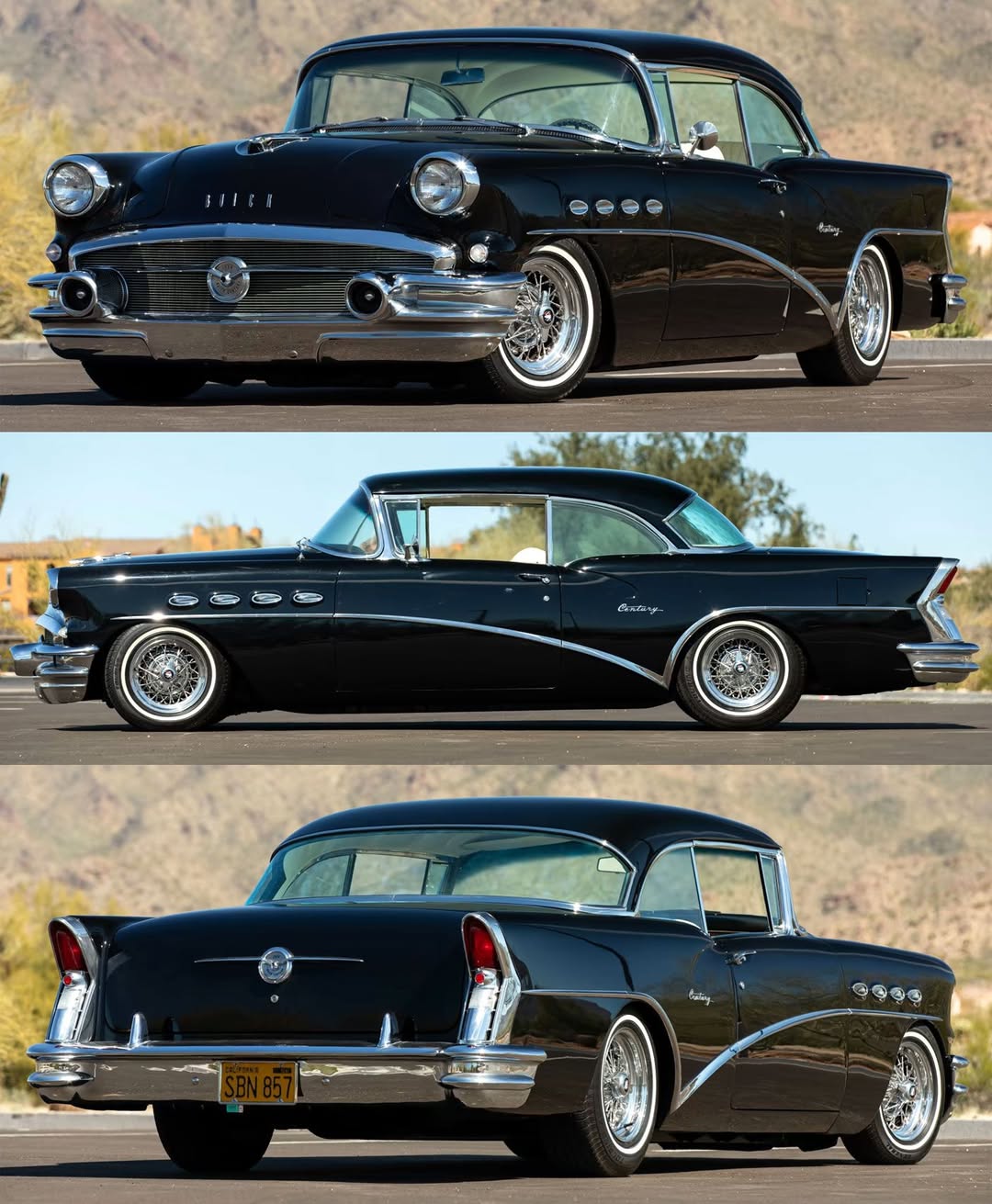
Source