The place where I found her was not somewhere anyone would choose to stand for long.
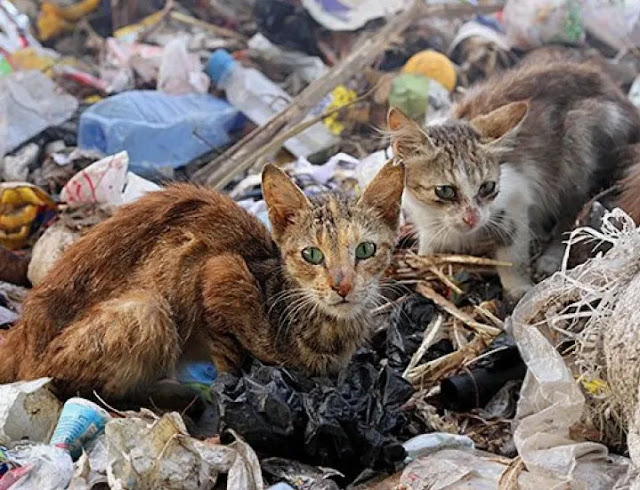
It was a strip of land beside a garbage dump on the edge of town — the kind of place where the air feels heavy and the ground seems permanently stained. The smell lingered thick and sour. Flies hovered in restless clouds. Torn plastic bags clung to weeds that had somehow forced their way through the dirt.
People passed it quickly, turning their heads away.
That was where she had been left.
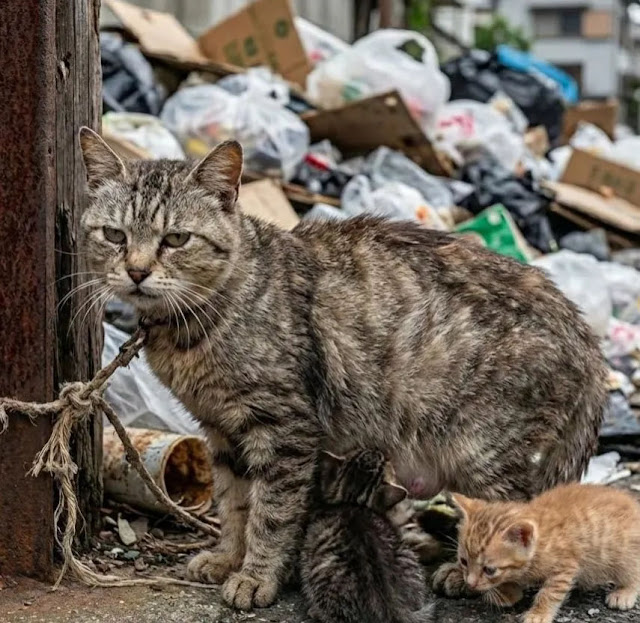
A mother cat, tied to a metal pole driven into the ground. And pressed tightly against her frail body were her kittens — too young to understand the danger they were in.
She could not move more than a few inches.
The rope around her neck was short and unforgiving, pulled tight enough that she had no chance of searching for food or shelter. It had rubbed away fur and left angry skin beneath. Every small shift of her body seemed to cost her effort.
Her kittens nudged against her belly, mewling softly, blind to the reality that they had been abandoned in a place no one would think to look.
Someone had brought her there.
Someone had taken the time to tie the knot, to secure it, to walk away knowing she could not escape.
It wasn’t carelessness. It wasn’t an accident.
It was a choice.
When I first approached, I expected panic. Most animals in distress either bolt or brace themselves to fight.
She did neither.
Her eyes followed me slowly. They were not wild with fear — they were dulled by exhaustion. She looked as though standing itself required more strength than she had left.
Her body trembled, not aggressively, but faintly — as if she had been holding herself upright for far too long.
Up close, the damage was clearer.
She was painfully thin. Her ribs pressed sharply against skin stretched tight. Her fur, once likely soft and clean, hung flat and dirty. Every breath she took seemed shallow and deliberate.
The kittens’ cries were weak and intermittent. Their small bodies pressed desperately against her, searching for warmth, searching for milk. They rooted instinctively, unaware that their mother’s body had almost nothing left to give.
She shifted slightly to make room for them, even though it clearly hurt.
That small movement said everything.
Even tied to a pole. Even starving. Even left beside a dump.
She was still trying to be their mother.
It was impossible not to imagine the moment she had been abandoned. The hands that secured the rope. The decision to leave without looking back.
She had likely struggled at first, pulling until the rope tightened further. Then hunger would have come. Then thirst. Then weakness.
But she had stayed upright as long as she could.
She remained alert despite her condition. When a truck rumbled in the distance, her head lifted a fraction. When a shadow crossed the ground, her eyes shifted toward it.
Even bound and exhausted, she was guarding her kittens.
I moved slowly toward her and knelt down. My hands shook as I reached for the rope. She flinched at the first touch — not from aggression, but from uncertainty. Then, as the tension around her neck began to ease, her body softened slightly.
The knot loosened.
The rope fell away.
For a second, she remained standing — as if unsure whether freedom was real. Then her legs gave out, and she nearly collapsed.
I caught her gently and gathered the kittens as quickly as I could.
They were alarmingly light in my hands. Cold. Too quiet.
She watched every movement, eyes following me as I lifted each tiny body. She didn’t hiss. She didn’t resist.
She just watched.
There was no time to lose.
I wrapped them together and hurried to the car, my mind racing ahead to the nearest veterinary clinic. Every red light felt endless. Every minute heavier than the last.
I kept glancing at her in the back seat. She lay on her side, breathing shallowly, her eyes half-open but unfocused. The kittens stirred weakly against her.
When we reached the clinic, the bright lights revealed the full extent of her condition.
The veterinarian’s expression changed the moment he examined her gums.
They were pale.
Her hydration levels were dangerously low. Her body temperature unstable. Her weight far below what it should have been for a nursing mother.
“She’s in very poor condition,” the vet said carefully.
Severely malnourished. Exhausted. Her body was on the edge of shutting down.
The kittens were alive, but fragile. Too young. Too dependent.
IV fluids were started immediately. A small catheter placed carefully into her vein. Medication followed to stabilize her organs and prevent infection.
Her body responded slowly, almost reluctantly — as if unsure whether it had the strength to keep fighting.
But even as the treatment began, her attention remained fixed on one thing.
Her kittens.
Whenever one of them made the faintest sound, her eyes shifted toward them. She attempted to lift her head, though her neck trembled with weakness.
The veterinary staff moved the kittens closer so she could see them.
The change was subtle, but unmistakable.
Her breathing steadied.
It was the first moment of calm she had likely experienced in days.
Her body had been drained of nearly everything — nutrients, hydration, energy. Yet she had stayed alive long enough to protect her kittens from the cold ground and the elements.
Instinct had carried her farther than strength.
The following hours were filled with uncertainty.
Her temperature fluctuated. Her blood pressure remained unstable. Each update from the clinic came with careful wording, cautious optimism.
The kittens were placed in a warm incubator, monitored constantly. They were too young to survive without assistance. Their survival depended on warmth, nourishment — and ideally, their mother’s recovery.
The vet explained the risks without dramatics.
Prolonged dehydration and starvation had strained her organs. Recovery would be slow. It was not guaranteed.
I sat in the waiting room, replaying the image of her tied to that pole. The rope. The dump. The way her body had trembled yet remained upright for her babies.
Minutes felt like hours.
Every time my phone buzzed, my heart leapt.
“She’s still alive,” the vet said during one update.
Alive.
That word became everything.
Alive meant possibility.
The kittens, too, remained stable under close watch. They slept in small clusters, unaware of how narrow their path had been. Their tiny chests rose and fell in steady rhythm beneath the warmth of blankets and careful hands.
This had not been an accident.
It had not been misunderstanding.
It had been a deliberate act meant to erase them.
Yet here they were.
Medical care cannot undo what was done. It cannot remove memory or pain.
But it can interrupt cruelty.
It can stand between abandonment and death and say, “No further.”
Each IV drip mattered. Each measured dose of medicine mattered. Each small improvement — a steadier breath, a flicker of appetite — felt monumental.
Days passed.
Her condition began to stabilize. Slowly.
She did not resist the hands that treated her. She did not hiss or swipe. She seemed to understand, in her quiet way, that these people were not there to harm her.
Strength, in her case, was not loud.
It did not roar.
It looked like breathing through weakness. It looked like keeping her eyes open when they wanted to close. It looked like surviving one more hour.
The kittens began to show clearer signs of life. Their cries grew stronger. They squirmed with more energy. Their bodies responded eagerly to warmth and nourishment.
Life, little by little, pushed back.
She rested more now, her breathing deeper and more regular. When the kittens were placed beside her under supervision, she turned her head toward them instinctively.
That bond had never broken.
The image of her tied beside that garbage dump still lingers in my mind. A living creature treated as disposable. A mother reduced to an inconvenience someone wanted gone.
But that image is no longer the final chapter.
She was seen.
That single moment — noticing her, stopping, kneeling beside her — changed everything.
Animals are abandoned every day. Many are never found. Their stories end in silence.
Hers did not.
Recovery is not a straight line. Some days brought setbacks — a drop in energy, a return of weakness. Other days brought visible progress.
But the direction had changed.
The kittens continue to grow stronger. Their bodies stretch, their movements more confident. They are no longer quiet bundles of fear but small lives reaching forward.
The mother cat rests now in a clean, warm space. Her eyes are clearer. The emptiness that once clouded them has been replaced with quiet watchfulness.
She was tied to a pole and left beside a garbage dump.
That was where someone decided her life no longer mattered.
But that decision did not get the final word.
She is still here.
Her kittens are still here.
They are alive not because cruelty failed to try — but because compassion showed up in time.
And sometimes, that is all it takes to turn a story of abandonment into one of survival.