1921 Hispano-Suiza H6B Skiff
Introduced at the 1919 Paris Motor Show, the H6 arrived with engineering that genuinely stood apart from anything else on the road.
Its power-assisted four-wheel drum brakes were so advanced that Rolls-Royce acquired a license to reproduce the system (in modified form), a telling indication of where Hispano-Suiza stood relative to its contemporaries.
The chassis was delivered only as a rolling unit, leaving the finest coachbuilders in Europe to compete for commissions.
This example carries a skiff body by Carrosserie Automobile Charles Duquesne of Tourcoing (the same firm cited in the Beaulieu Encyclopaedia of the Automobile in connection with a torpedo tourer on an H6B from 1921), placing it among the more individual survivors of the model.
Beneath the hood sits Marc Birkigt’s 403 cubic inch (6.6 liter) single-overhead-camshaft inline six, essentially one half of a proposed V12 aircraft design.
Seven main bearings, aluminum pistons in steel-sleeved cylinders screwed into a light-alloy block, pressure-fed lubrication, and approximately 135 horsepower at 2,400 rpm ran through a three-speed gearbox built in unit with the engine.
Approximately 2,200 examples of all H6-series variants (including H6, H6B, and H6C) were completed between 1919 and 1933.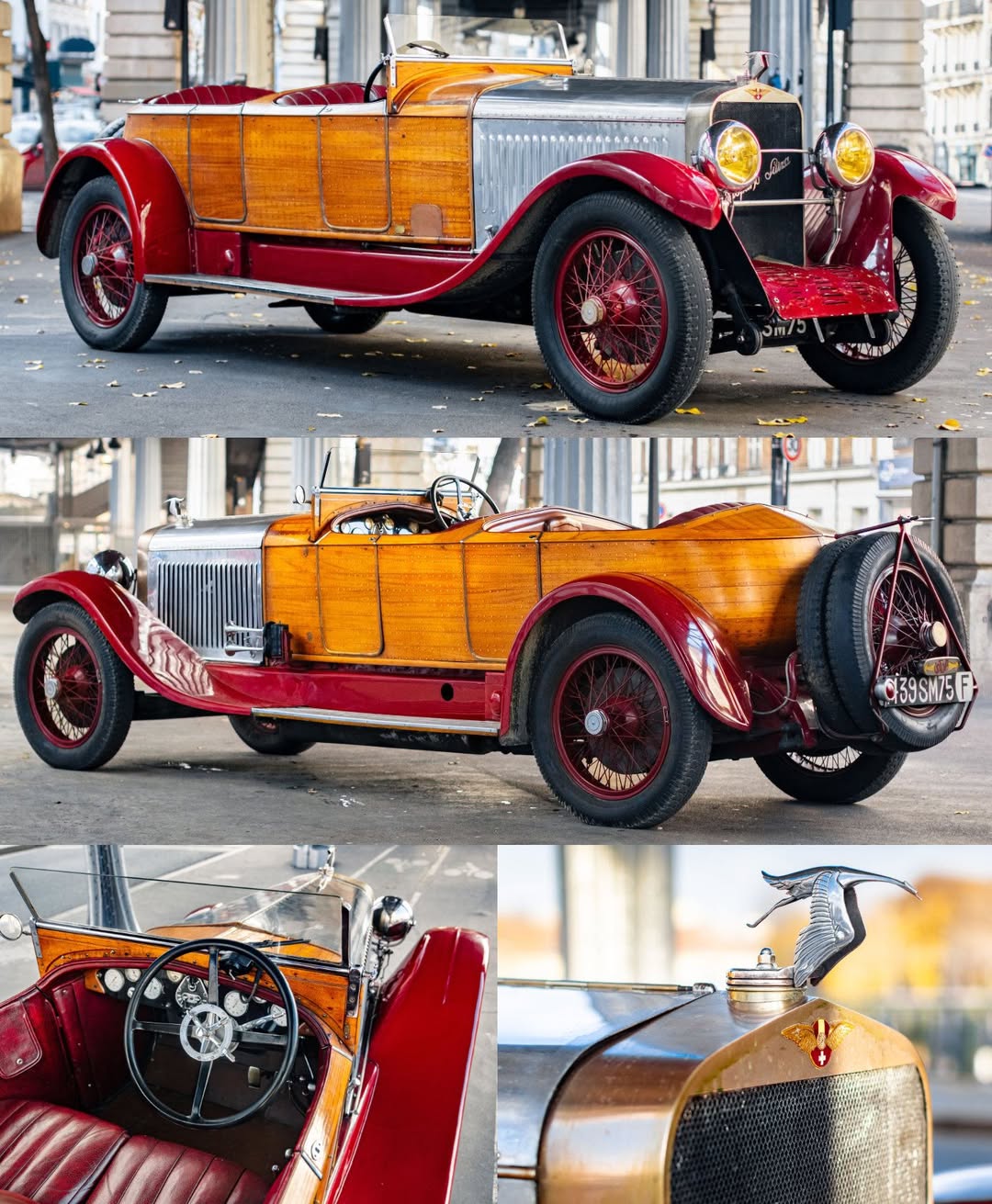
Source