1929 Stutz Model M Supercharged Coupe
Just three factory supercharged Model M automobiles are known to survive today, placing this among the scarcest American performance cars of the late 1920s.
The program’s origin was Le Mans: a French syndicate entered a stock Stutz Black Hawk in 1928 and finished 2nd overall, covering 2,667 miles at an average of 68.01 mph, the best result by an American car at the race until 1966.
Facing Bentley’s formidable new 6½ Litre for 1929, Stutz responded by developing a centrifugal supercharger mounted at the front of the engine and engaged via a driver-controlled mechanism.
With the supercharger active, output was quoted at approximately 155 to 165 bhp in competition trim. Three supercharged cars ran at Le Mans in 1929; two retired, and the surviving entry finished 5th overall.
Road-going supercharged cars were sold through Warwick Wright Ltd., Stutz’s British distributor, and bodied by various coachbuilders. This example carries coachwork by Lancefield of London, a firm known for more streamlined themes than many of its contemporaries.
Lancefield’s signature features included helmet fenders, skirted running boards or step plates, gun-turret tops, and ample louvers along the lower bodywork.
The aluminum body (approximately 3,800 pounds, 1,724 kg overall vehicle weight as equipped) was commissioned through London coachwork broker Brainsby-Woolard, one of several supercharged Stutz coupes with similar but non-identical Lancefield coachwork produced in 1929.
The 325 CI SOHC inline eight is backed by a four-speed manual transmission, with semi-elliptic leaf springs at both axles and four-wheel hydraulic drum brakes.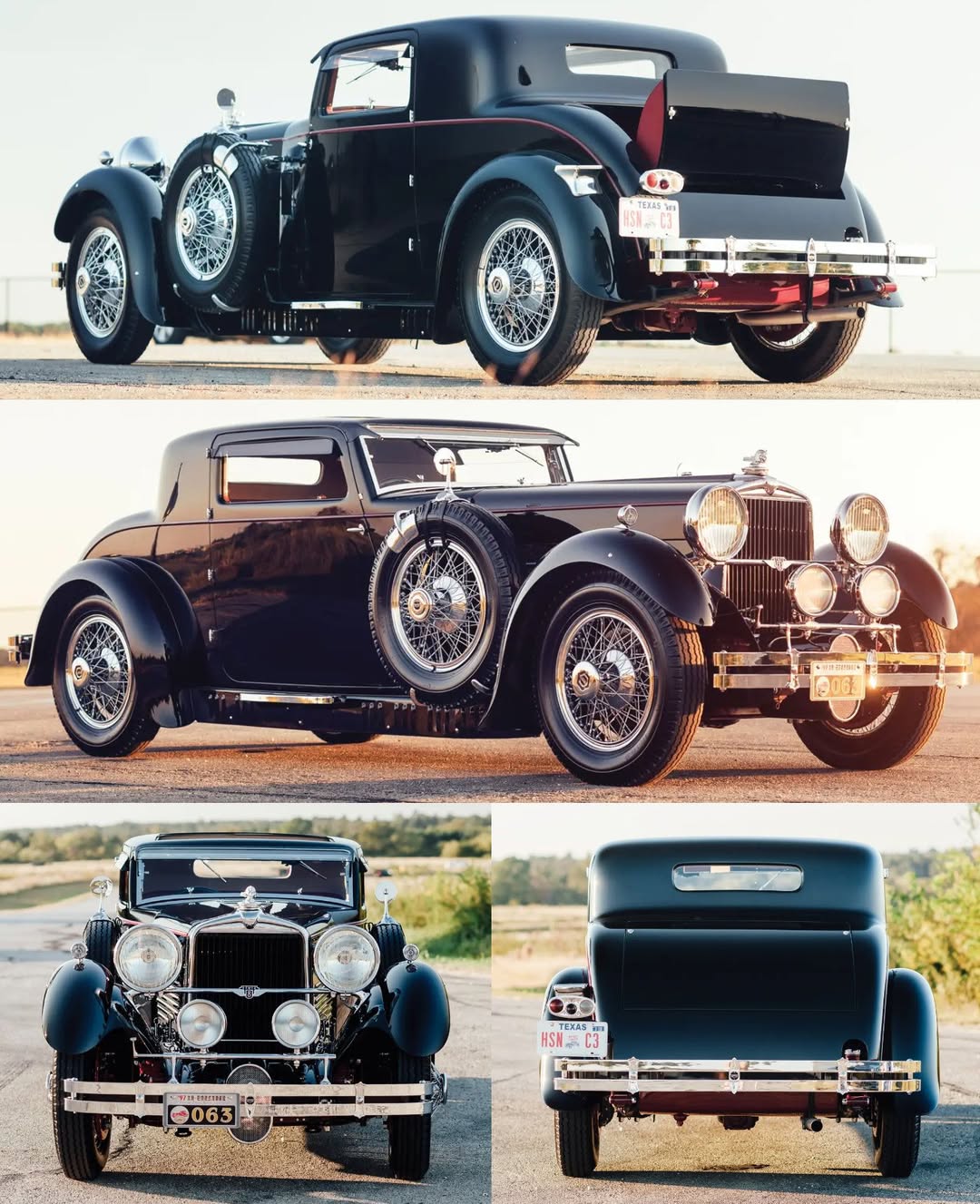
Source