1938 Lincoln Zephyr Coupe
One of the few American cars of the 1930s to genuinely challenge European thinking on aerodynamic design, the Lincoln Zephyr arrived with a teardrop profile and unit body construction that set it apart from most domestic competition.
The three-window coupe body style, added to the lineup for 1937, gave the car a particularly clean silhouette. For 1938, designer E.T. “Bob” Gregorie restyled the nose, repositioning the twin auxiliary grilles into the forward sections of the front fenders to improve engine cooling while sharpening the car’s appearance.
The body was built on an advanced bridge-truss integral frame (among the earliest applications of unit construction on an American production car), reducing weight while increasing rigidity. Credit for the original design is shared between John Tjaarda of Briggs Body Company, Gregorie, and Edsel Ford.
Under the hood sat a 267 CI flathead V12 producing 110 hp, derived from Ford’s flathead V8 architecture but expanded to twelve cylinders at a 75-degree bank angle. Aluminum-alloy heads and dual water pumps were part of the package, and the engine’s broad torque curve made it well-suited to sustained highway travel.
The Zephyr’s influence reached well past its own production run. Its platform and proportions served as the direct foundation for Edsel Ford’s Lincoln Continental, introduced as a 1940 model.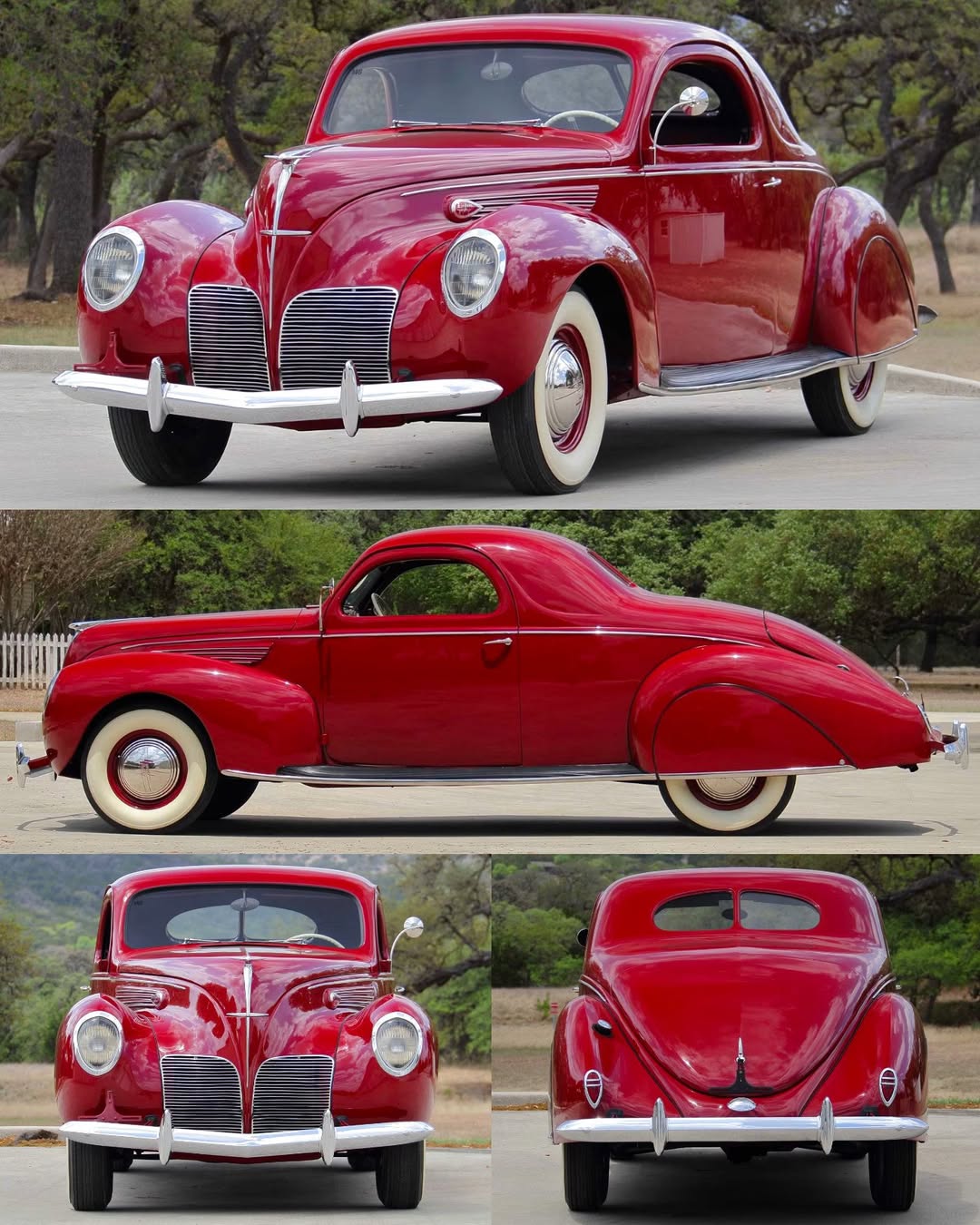
Source