1954 Satecmo ‘Eolia’
Constructed from a magnesium berlinetta body argon-welded after wind tunnel development at the Eiffel laboratory, the Éolia carries a silhouette defined by a low roofline, pronounced twin tail fins, and paired engine-access doors at the rear flanking the two passenger doors.
The bodywork’s unusual material and fabrication method weren’t cosmetic choices. Claude used magnesium specifically to minimize weight, and the argon welding was required to keep the alloy from oxidizing during construction.
André Georges Claude (son of physicist Georges Claude, inventor of the commercial neon sign, and designer of the five-speed gearbox that equipped Rédélé’s class-winning 4CV 1063 at the 1954 Mille Miglia) built the Éolia as a purpose-engineered French competition car using components from his own Satecmo tuning business.
The original 4CV-derived four-cylinder was later replaced around 1960 by an 850cc Renault Dauphine Gordini unit, tuned by Renault specialists Mignotet, who later went on to build engines for Alpine, producing 69 hp at 6,200 rpm.
The five-speed Claude gearbox remained. A 24-gallon (90-liter) fuel tank sits at the front of the car, balancing the mid-rear engine position. Steering is right-hand drive by Claude’s deliberate preference. Top speed is rated at 104 mph.
Completed in 1954 but not registered until October 1958 under plate 860 HK 75, the Éolia was subsequently shown to several French manufacturers and, reportedly, to Porsche in Stuttgart. It remains a single example.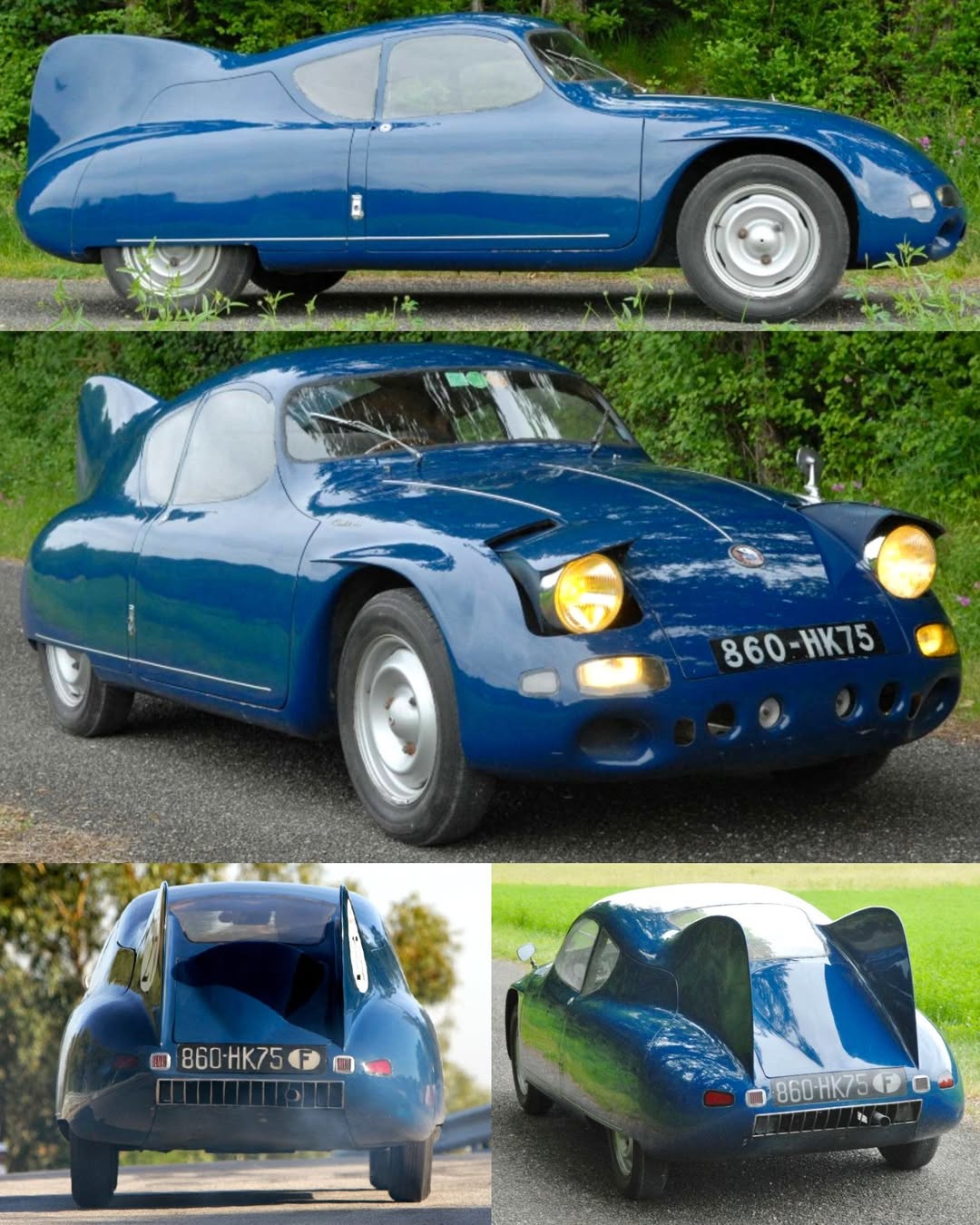
Source