1960 Ford Thunderbird Convertible
The 1960 Ford Thunderbird marked the final year of the second-generation “Square Bird,” a model that redefined Ford’s image in the personal luxury segment. Introduced in 1958, this generation transformed the Thunderbird from a two-seat sports car into a four-passenger grand touring coupe and convertible, emphasizing comfort, style, and refinement.
It was also the first Thunderbird to feature unitized (monocoque) construction, giving it a lower stance and improved rigidity. The 1960 model stood just 52.5 inches tall and offered 5.3 inches of ground clearance, giving it a sleek, road-hugging profile. Of the 92,843 Thunderbirds built in 1960, only 11,860 were convertibles, making them especially desirable today.
Among those, just 250 convertibles were equipped with the optional J-code 430 cubic inch (7.0-liter) V8, sourced from Lincoln’s MEL (Mercury-Edsel-Lincoln) engine family. This powerplant produced 350 horsepower and an impressive 490 lb-ft of torque at 2,800 rpm, paired exclusively with Ford’s Cruise-O-Matic automatic transmission. The J-code option added $177 to the Thunderbird’s base price, offering buyers unmatched performance for the era.
Underneath, the Thunderbird featured independent front suspension with upper and lower ball joints and coil springs, while parallel leaf springs supported the rear axle. Four-wheel hydraulic drum brakes provided stopping power, typical of the period.
Luxury amenities included power windows, power-adjustable front seats, air conditioning, and a power-operated convertible top, all contributing to the Thunderbird’s reputation as a sophisticated boulevard cruiser rather than a pure sports car.
The 1960 Thunderbird Convertible remains one of the most iconic examples of early American personal luxury design; a car that combined advanced engineering, elegant styling, and effortless V8 power in a way that set the tone for decades of Ford’s premium offerings.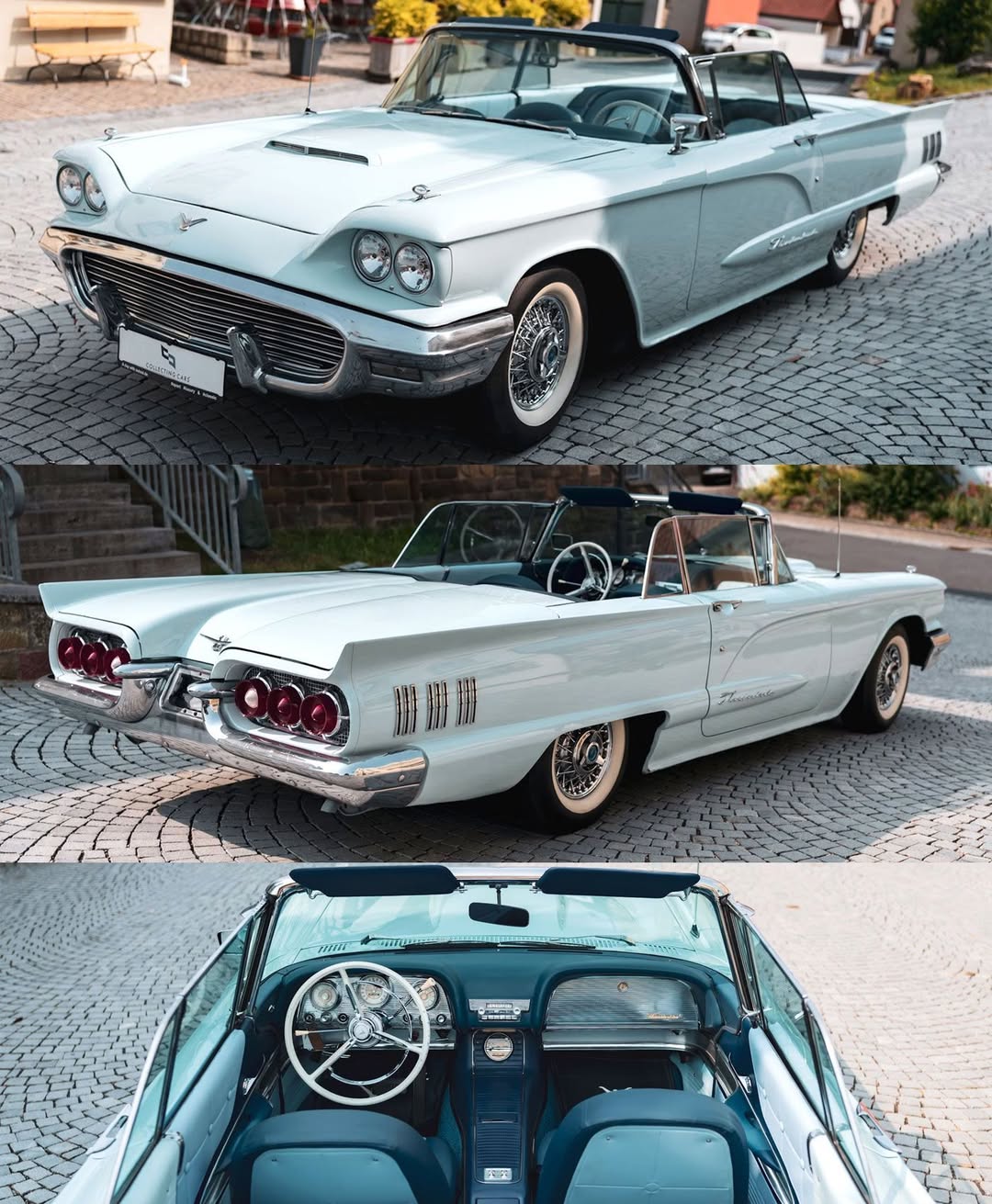
Source