1948 Jaguar Mark IV 3½-Litre Drophead Coupe
Long front fenders, running boards, and a chromed, upright radiator surround established the Mark IV’s visual identity in the late 1930s; the car Jaguar sold from 1945 onward was largely the same body under a new marque name, the company having traded its SS designation for Jaguar in March 1945.
William Lyons oversaw the design of the coachwork, offered in saloon and drophead forms on a 120-inch wheelbase.
The 3½-Litre Drophead was the range-topper: a full five-seater whose three-position hood could run fully open, fully closed, or in the coupé de ville arrangement with only the rear section raised.
Power came from a 3.5-liter Standard Motor Company seven-bearing inline-six fitted with an overhead-valve cylinder head developed by Harry Weslake and engineer William Heynes, producing 125 hp on twin SU carburetors and capable of over 95 mph.
The separate chassis used semi-elliptic leaf springs at both ends with Girling mechanical drum brakes and Burman worm-and-nut steering.
Jaguar produced 3,162 3½-litre examples across both the pre-war SS and post-war periods, with the range superseded by the Mark V in 1949.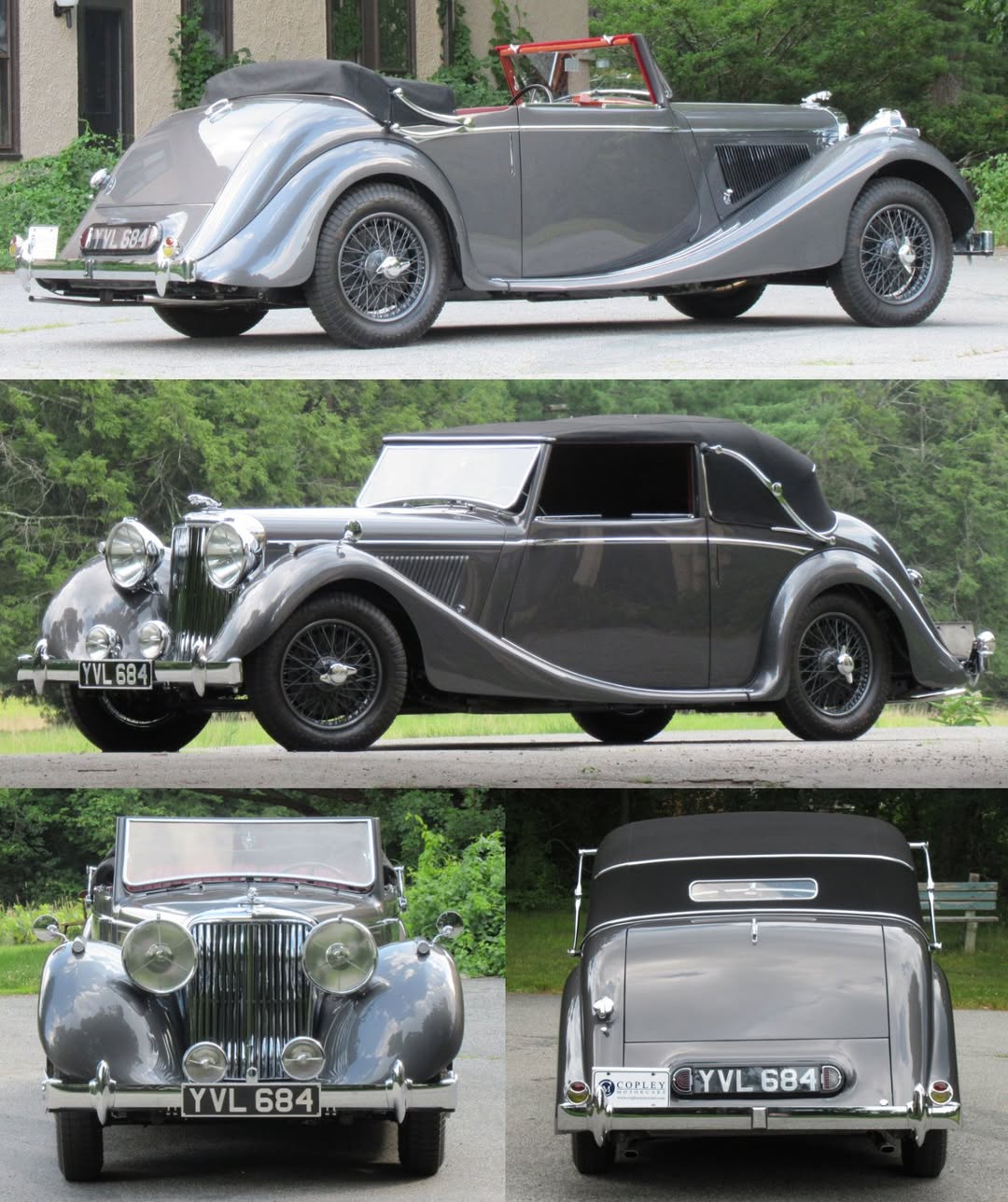
Source