1984 Lotus Etna
Giorgetto Giugiaro’s Turin-based Italdesign studio created this angular wedge-shaped concept on a lengthened Esprit platform, stretching the wheelbase to about 99 inches to accommodate the all-new Type 909 V8 powerplant.
Chief Engineer Tony Rudd developed the engine by effectively joining two of Lotus’s slant-four units into a new 4.0-liter block with dual overhead camshaft heads, displacing roughly 244 cubic inches and generating a quoted 330-335 horsepower at 6,500 rpm.
Unveiled at Birmingham’s 1984 British International Motor Show, the Etna featured advanced technologies Lotus was developing for Formula One and road-car application, including projected computer-controlled active suspension with anti-dive and anti-squat characteristics, traction control, and anti-lock braking.
Active noise cancellation was discussed in period as part of Lotus engineering research but remained more an experimental idea than a fully realized feature of the static show car.
The aerodynamic body achieved an estimated 0.29 drag coefficient, with a distinctive Perspex canopy providing visibility over the cabin and contributing to the concept’s low-drag profile.
Only two Type 909 engines were constructed, with one intended for the Etna and Lotus retaining the other unit for development work.
Originally fashioned as a styling model from wood, clay, and fiberglass rather than a functional prototype, the Etna generated an enthusiastic reception but financial constraints prevented production development.
General Motors’ 1986 acquisition of Lotus later redirected company priorities toward more practical and profitable projects, ultimately yielding the front-drive Elan instead of a production V8 supercar based on the Etna theme.
Decades later, restoration specialist Ken Myers (working in the UK, often cited as Ken Myers or Ken Myers Engineering) was involved when the Etna concept was rebuilt into an operational car using Esprit suspension and running gear, with mechanicals built up around a Type 909-based V8 and a replacement Perspex canopy.
The car that resulted gave enthusiasts a glimpse of what Lotus’s first V8-powered supercar of the 1980s might have been like had the Etna reached production.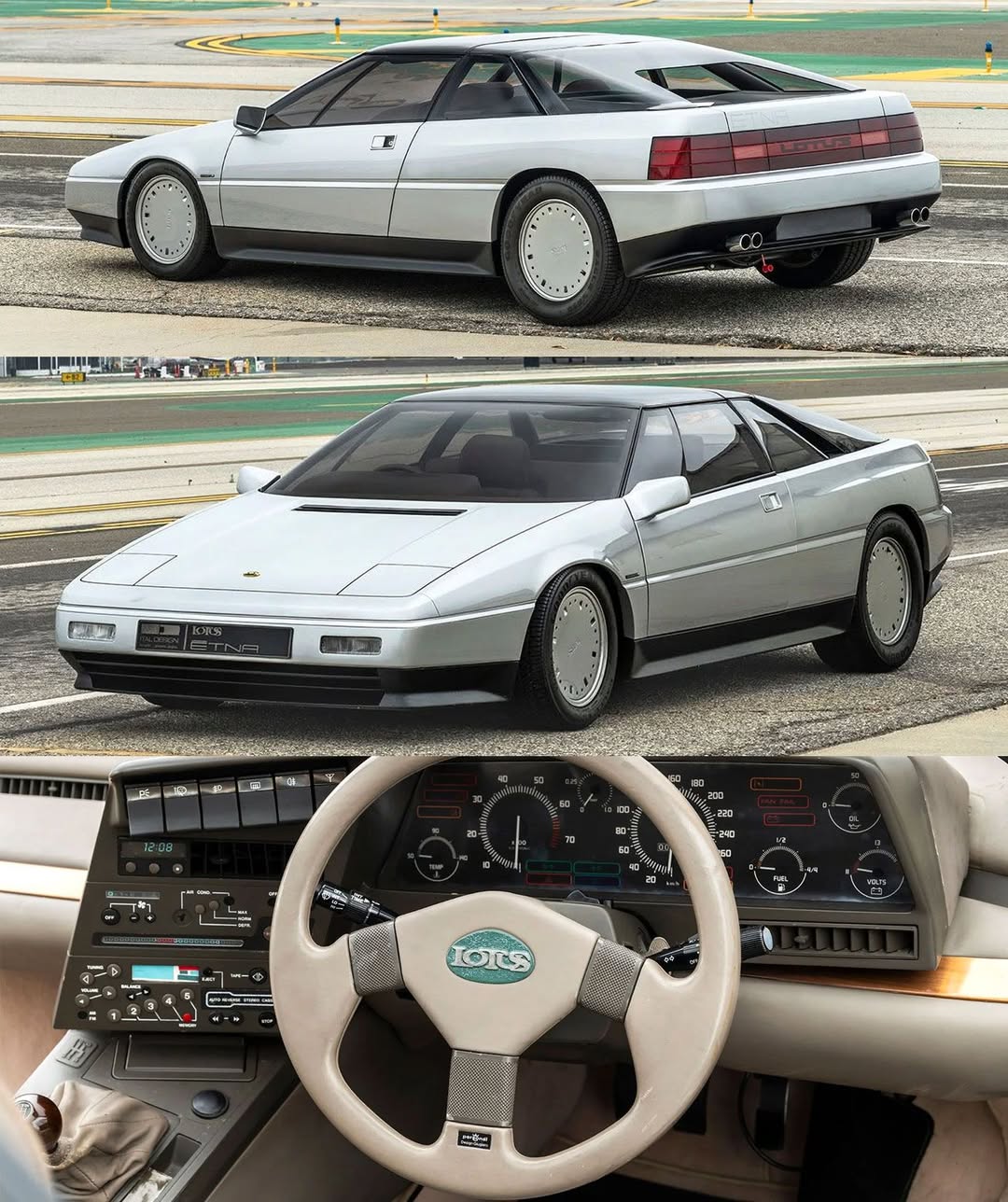
Source