1914 Mercedes 28/95 Phaeton
Designed in 1914 to replace the four-cylinder 37/90, the 28/95 didn’t reach meaningful production until after World War I, with series production running from 1920 through 1924 (approximately 590 were built in total).
The engine was a six-cylinder unit closely derived from Daimler’s DF80 aircraft powerplant, featuring a single overhead camshaft driven by a vertical shaft and bevel gears. The cylinders were cast in pairs and bolted to an aluminum crankcase.
Two Zenith updraft carburetors fed individual intake passages to each cylinder. Displacement was 444 cubic inches (7.3 liters), producing 95 horsepower at 1,800 rpm through a four-speed manual gearbox.
The 28/95 was also the first Mercedes to carry the V-shaped radiator grille that would become a brand signature. Curb weight was approximately 4,200 pounds (1,905 kg), depending on coachwork.
Its chassis was notably stiff for the period, with solid axles front and rear, semi-elliptic leaf springs, and rear-wheel drum brakes on early examples (four-wheel drums were phased in from 1923).
A short-wheelbase variant followed, and a supercharged 28/95K option pointed the way directly toward the legendary S, SS, SSK, and SSKL models of the late 1920s.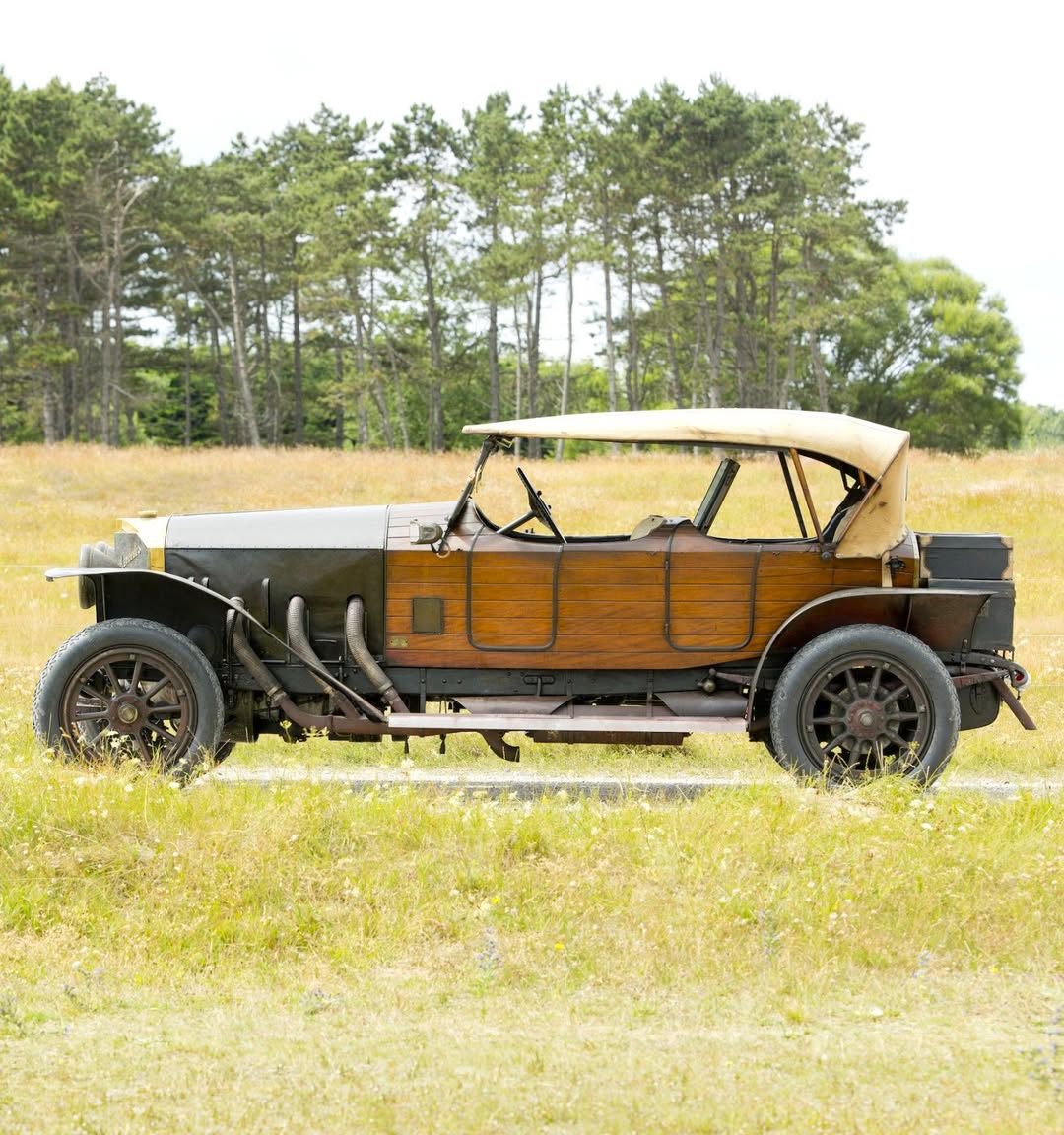
Source