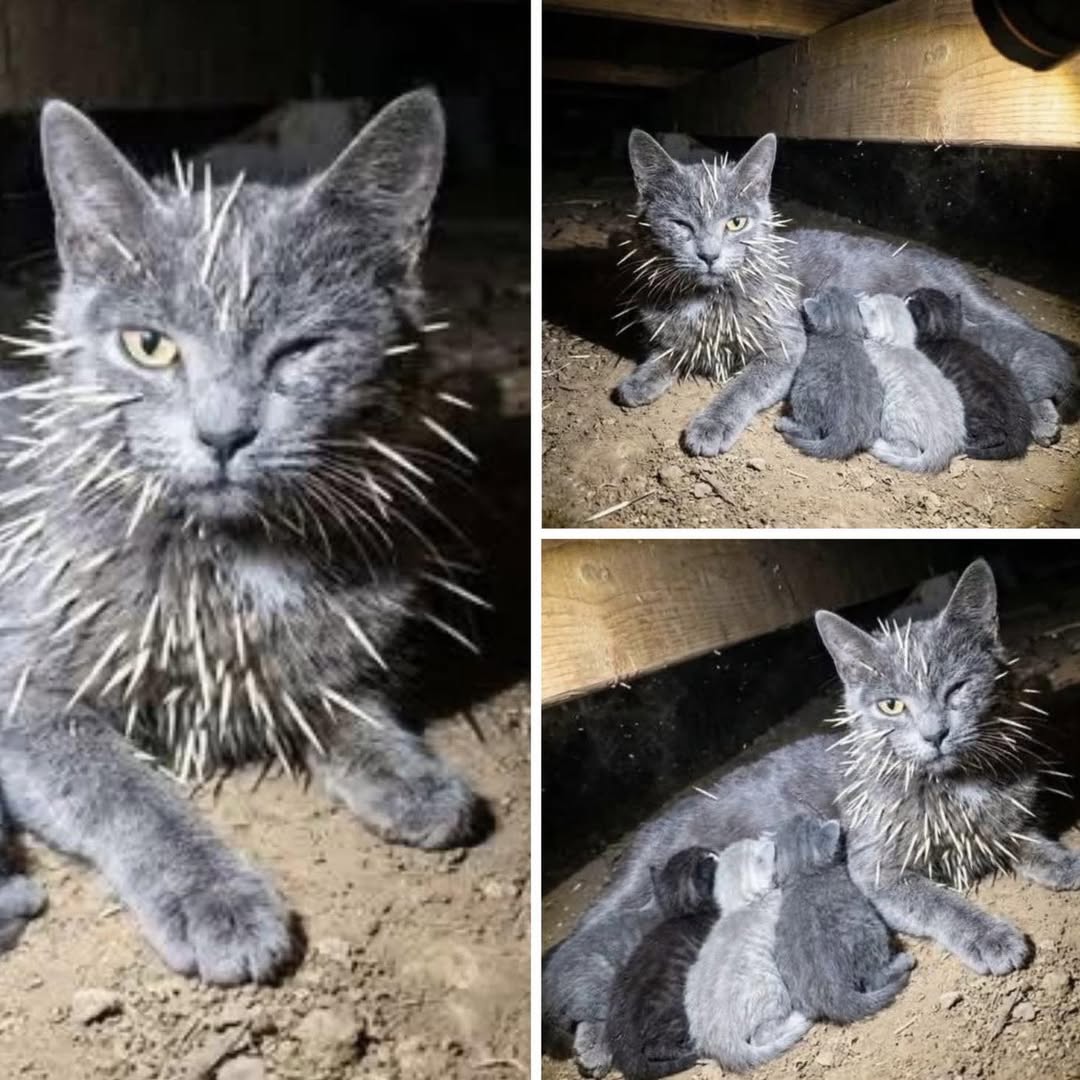
She had 47 porcupine quills in her face, chest, and front legs.
She hadn’t moved from her kittens in two days.
The porcupine never reached them.
Not a single quill touched a single kitten.
She took every one.
It happened in late September 2023, deep in the backcountry of northern British Columbia. A logger noticed a strange smell coming from beneath his equipment shed. He figured something had died under there. But when he crouched down with a flashlight, he saw her.
A small blue-grey cat, lying on her side in the dirt, nursing four kittens.
Her face was covered in porcupine quills.
Not a few. Forty-seven. The vet counted them later.
They were embedded across the entire left side of her face—through her cheek, her upper lip, the soft tissue around her eye, which was swollen nearly shut. Seven quills pierced her ear from front to back. More ran across her chest and down both front legs, with three driven straight through the pad of her left paw and out the other side.
Each quill was about four inches long. Cream-coloured with dark, barbed tips designed to dig deeper with every movement.
She’d been like that for two days.
Still nursing.
Her four kittens—two blue-grey like her, one pale silver, one dark charcoal—were pressed against her belly. All four were feeding. All four were clean. Not one had a single quill.
The logger, with over thirty years of experience in the bush, understood instantly.
Porcupines are common in timber country. They chew wood, wiring, anything with salt. They’re slow-moving and rely on their quills for defense. They’re not aggressive. But they’re big—adults weigh 20 to 35 pounds. This cat weighed maybe seven.
Cats don’t go after porcupines. Every instinct tells them to stay away.
Unless something threatens their kittens.
The porcupine had likely wandered under the shed, following a scent trail. It got too close. And this seven-pound cat attacked an animal four times her size to drive it away from four babies who couldn’t run, couldn’t hide, and had no way to defend themselves.
She won. The porcupine left. The kittens were untouched.
But the quills stayed.
Porcupine quills have microscopic barbs that drive deeper with every movement. They can’t be scratched out or rubbed off. They migrate inward, causing infection, abscesses, and organ damage if not removed.
For two days, she lay in the dirt with 47 barbed spines in her body. Every time she moved to groom a kitten, the quills in her cheek and lip pushed deeper. Every time she shifted to let them nurse, the ones in her chest and legs drove further into muscle.
She didn’t leave the nest.
She didn’t stop nursing.
She didn’t stop grooming.
She chose pain—again and again—for two days straight.
The logger drove her and the kittens 90 minutes to the nearest vet. Removal took over two hours under sedation. Each quill had to be pulled out individually with surgical forceps. Eleven were so deep they required small incisions. The ones through her paw needed careful removal from both sides. The swelling near her eye took three weeks of antibiotics to heal.
She kept her eye. She kept all four legs. She made a full recovery in about six weeks.
The scars are still there—tiny round marks across her face and chest. Her fur grew back over most of them, but her left ear has three permanent holes where the cartilage never healed.
The logger kept all five. He’d never owned a cat before.
He named her Quill.
She’s a quiet, small, blue-grey cat who sleeps in a bed he built from an old crate lined with fleece. Her four kittens—now fully grown—pile in with her every night.
She fought something four times her size in the dark under a shed.
She won.
And she paid for it with 47 wounds she carried in silence while she kept four tiny lives alive.
She never made a sound.